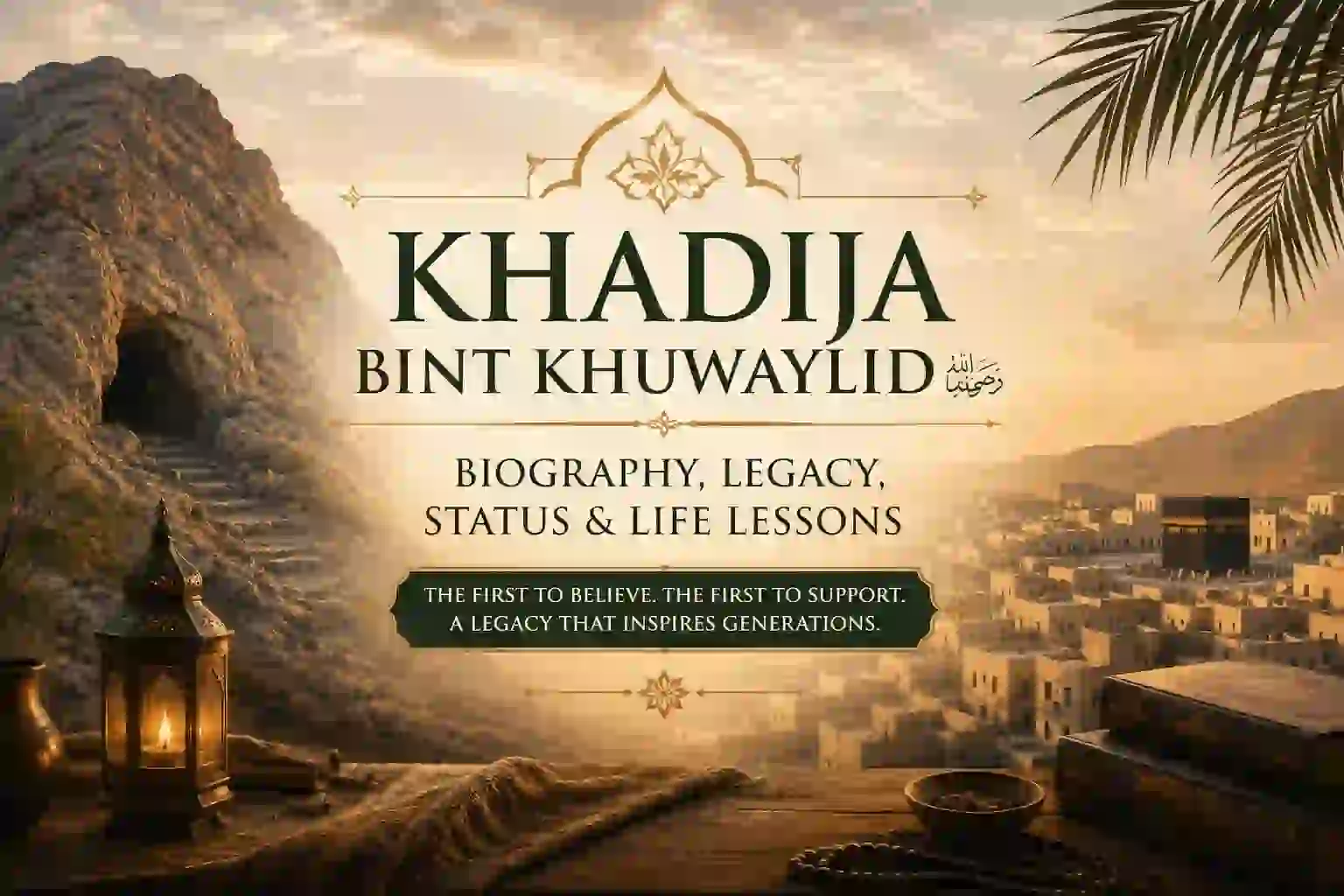
Khadija bint Khuwaylid رضي الله عنها was the first wife of Prophet Muhammad ﷺ and one of the most honoured women in Islamic history. She was the first person to believe in his Prophethood according to the established accounts of the beginning of revelation, and she remained beside him through the earliest and most difficult years of his mission.
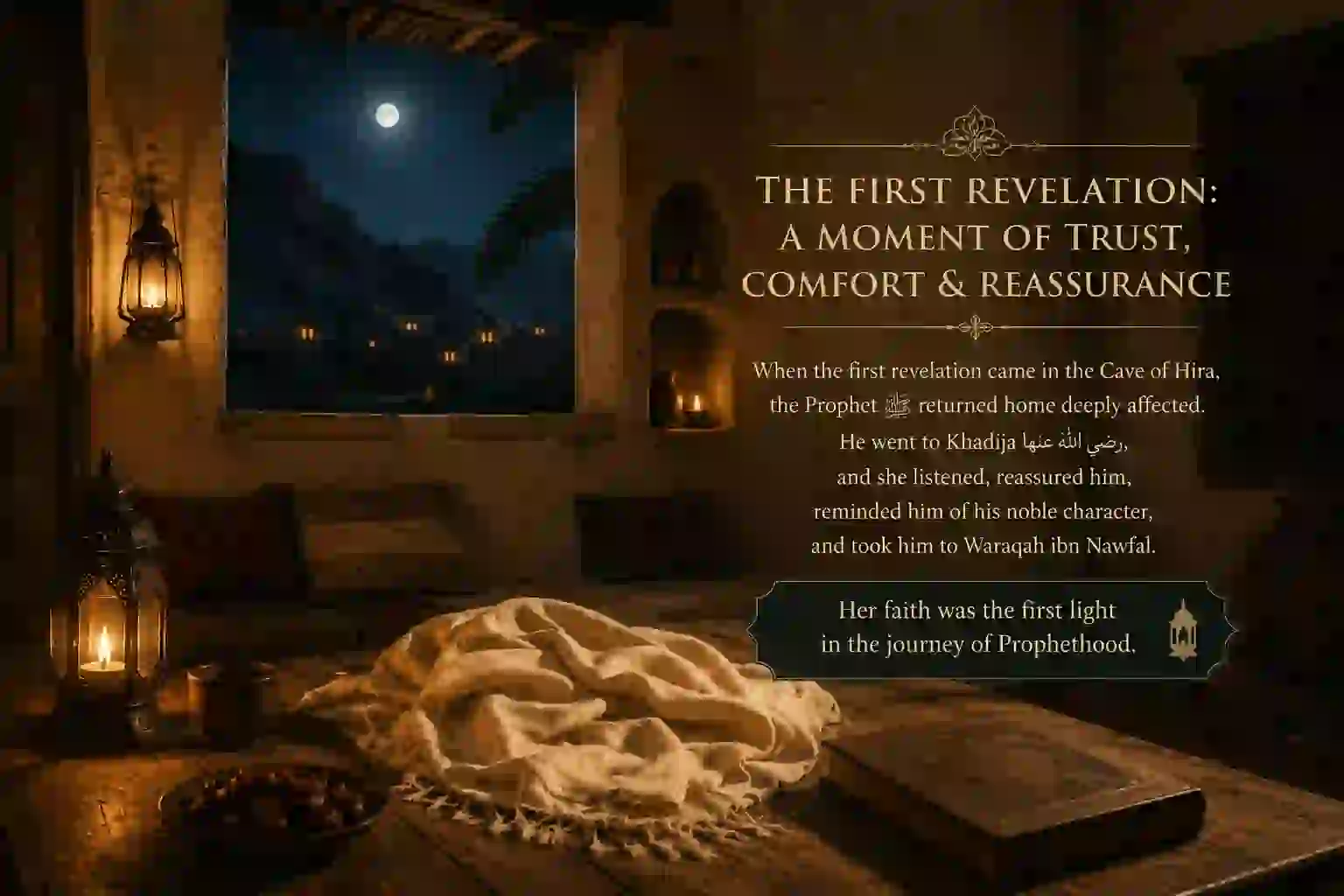
Her significance goes far beyond her marriage to the Prophet ﷺ. Khadija رضي الله عنها was known for her faith, dignity, generosity and steadfastness. When the first revelation came to Muhammad ﷺ in the Cave of Hira, she was the person he returned to. She listened to him, reassured him, reminded him of the qualities she knew in him and took him to Waraqah ibn Nawfal.
The account of the beginning of revelation and Khadija’s response is authentically recorded in Sahih al-Bukhari and Sahih Muslim.
Her life therefore connects several important moments in Islamic history: the life of Muhammad ﷺ before Prophethood, the beginning of Quranic revelation, the earliest Muslim community and the difficult Makkan period.
For Muslims today, her story also provides a meaningful example of faith, character, patience, family support and steadfastness during hardship.
Table of Contents
- Who Was Khadija bint Khuwaylid?
- Khadija’s Life Before Her Marriage to Prophet Muhammad ﷺ
- Khadija’s Marriage to Prophet Muhammad ﷺ
- Khadija and the Beginning of Revelation
- How Khadija Supported the Prophet ﷺ After the First Revelation
- Khadija Was the First to Believe
- Khadija’s Role During the Early Years of Islam
- The Status of Khadija bint Khuwaylid in Islam
- Khadija’s Character and Virtues
- Khadija’s Family
- The Difficult Years in Makkah
- The Death of Khadija bint Khuwaylid
- Why Khadija’s Story Matters
- Lessons Muslims Can Learn from Khadija bint Khuwaylid
- Khadija’s Legacy
- Why Khadija Remains an Important Role Model
- Frequently Asked Questions About Khadija bint Khuwaylid
- Conclusion
- Sources and Further Reading
Who Was Khadija bint Khuwaylid?
Khadija bint Khuwaylid ibn Asad ibn Abd al-Uzza ibn Qusayy belonged to the Banu Asad clan of Quraysh in Makkah.
Historical and sīrah sources describe her as a respected woman of wealth and standing. Accounts of her life before Islam also describe her involvement in commerce and her practice of entrusting others with business journeys. Muhammad ﷺ was among those who worked on her behalf before receiving revelation.
The detailed accounts of Khadija’s commercial life come mainly from sīrah and historical literature rather than the strongest collections of hadith. For this reason, individual details should be considered according to the strength of their sources rather than presented as equally certain.
This distinction is important when studying Islamic history. A reliable account should separate:
- Events established through authentic hadith.
- Reports preserved in the sīrah tradition.
- Historical details over which scholars differ.
- Popular accounts that cannot be established with the same level of certainty.
What is firmly established is the exceptional position Khadija رضي الله عنها held in the life of Prophet Muhammad ﷺ and the special honour given to her in authentic Prophetic teachings.
Khadija’s Life Before Her Marriage to Prophet Muhammad ﷺ
Before revelation began, Muhammad ﷺ was already known among the people of Makkah for his honesty and trustworthy character.
The established sīrah tradition describes Khadija رضي الله عنها entrusting him with a trading journey. His conduct strengthened the trust placed in him, and their commercial relationship preceded their marriage.
Some popular accounts add further details about this journey. Because these additional reports do not all have the same level of historical reliability, they should not be presented as established facts without qualification.
For this reason, the safest approach is to distinguish between the established core of the story and later historical details.
This allows us to appreciate Khadija’s life without presenting every report found in later sīrah literature with the same level of certainty as an authentic hadith.
Khadija’s Marriage to Prophet Muhammad ﷺ
Khadija رضي الله عنها married Muhammad ﷺ before the beginning of his Prophethood.
The well-known historical account states that Muhammad ﷺ was twenty-five years old when they married. The commonly reported view places Khadija رضي الله عنها at forty, although other historical reports give different figures.
Because her exact age at marriage is not established through an authentic hadith, forty is better described as the commonly reported historical view rather than an undisputed fact.
Their marriage continued until Khadija’s death, and the Prophet ﷺ did not marry another woman while she was alive.
This marriage therefore covered the years immediately before revelation as well as the earliest years of the Prophetic mission.
Khadija رضي الله عنها was not only the Prophet’s wife before his Prophethood. She was also the person he returned to at one of the most significant moments of his life.
Khadija and the Beginning of Revelation
The beginning of revelation is central to the story of Khadija رضي الله عنها.
Aisha رضي الله عنها narrated that revelation began with true dreams and that the Prophet ﷺ later developed a love of seclusion. He would spend time in the Cave of Hira worshipping Allah before returning to his family for provisions and then going back to the cave.
Eventually, while he was in the Cave of Hira, the angel Jibril عليه السلام came to him and commanded him to read.
The Prophet ﷺ returned home deeply affected by what had happened and asked to be covered.
He went to Khadija رضي الله عنها.
The account of these events is authentically reported in Sahih al-Bukhari and Sahih Muslim.
How Khadija Supported the Prophet ﷺ After the First Revelation
Khadija’s response to the first revelation is one of the clearest examples of her character.
The Prophet ﷺ told her what had happened and expressed his fear. Rather than dismissing his experience, she reassured him by referring to the qualities she already knew in him.
She reminded him that he maintained family ties, spoke truthfully, helped those in need, honoured guests and supported people facing hardship.
Her response was significant because it was based on his established character.
She then took the Prophet ﷺ to Waraqah ibn Nawfal, who had knowledge of earlier scripture. After hearing the Prophet’s account, Waraqah identified the visitor as the angel who had come to Musa عليه السلام and warned that the Prophet ﷺ would face opposition from his people.
The event is authentically reported in Sahih al-Bukhari.
This moment places Khadija at the centre of one of the most important events in Islamic history.
It also reveals something important about her character: when faced with an extraordinary situation, she responded with reassurance, trust and practical support.
Khadija Was the First to Believe
Khadija رضي الله عنها is recognised by scholars of sīrah and Islamic history as the first person to believe in Prophet Muhammad ﷺ and his message.
The authentic account of the first revelation provides the context for this distinction. She listened to the Prophet ﷺ, reassured him, believed what he told her and helped him seek further understanding from Waraqah ibn Nawfal.
Her faith came at the very beginning of the Prophetic mission, before Islam had become established in Makkah and before the Prophet ﷺ had gathered a wider community around him.
Her position was therefore unique: she believed when the message was still new and the future was unknown.
Khadija’s Role During the Early Years of Islam
The early Makkan period brought increasing opposition to the Prophet ﷺ and those who followed him.
Khadija رضي الله عنها remained beside him during this period.
Her role should not be reduced to financial support alone. She was his wife and companion and provided a trusted presence within the household during the earliest stage of his mission.
The first-revelation account itself shows the importance of this support. When the Prophet ﷺ returned from Hira, he returned home to Khadija.
Her response was calm, reassuring and grounded in what she knew of his character.
Supporting someone through hardship does not always mean having every answer. Sometimes it means providing the trust and stability that allow another person to face what lies ahead.

The Status of Khadija bint Khuwaylid in Islam
Khadija رضي الله عنها holds a special status in Islam that is established through authentic hadith.
The Prophet ﷺ said:
«“The best of the world’s women is Mary (at her lifetime), and the best of the world’s women is Khadija (at her lifetime).”»
This narration is recorded in Sahih al-Bukhari.
Another authentic narration records that Jibril عليه السلام came to the Prophet ﷺ and conveyed greetings to Khadija from Allah, together with glad tidings of a house for her in Paradise where there would be neither noise nor fatigue.
These narrations show that Khadija’s status was not simply connected to her marriage to the Prophet ﷺ. Her faith and virtues were honoured in the Prophetic Sunnah.
Khadija’s Character and Virtues
The first-revelation narration gives us a particularly valuable insight into character.
When Khadija رضي الله عنها reassured the Prophet ﷺ, she referred to qualities including truthfulness, maintaining family ties, helping people in need, honouring guests and supporting those facing hardship.
Her response shows that good character can become a source of strength during difficult moments.
Her example can be associated with qualities such as:
- Faith
- Wisdom
- Compassion
- Generosity
- Patience
- Loyalty
- Trust
- Family support
These qualities are especially meaningful because they were reflected in her response to the Prophet ﷺ when he needed reassurance.
Khadija’s Family
Khadija رضي الله عنها was the mother of the Prophet’s children except Ibrahim.
The commonly recognised children of Khadija رضي الله عنها and Prophet Muhammad ﷺ were:
- Al-Qasim| Son
- Abdullah| Son
- Zaynab| Daughter
- Ruqayyah| Daughter
- Umm Kulthum| Daughter
- Fatimah رضي الله عنها| Daughter
- Ibrahim was born later to Maria al-Qibtiyya.
Khadija’s family was closely connected to the earliest years of the Prophetic household. Her daughter Fatimah رضي الله عنها would later become one of the most prominent women in Islamic history.
The Difficult Years in Makkah
As the message of Islam became public, opposition in Makkah increased.
Khadija رضي الله عنها remained with the Prophet ﷺ during this difficult period.
Her story shows that supporting someone through hardship does not always mean removing the difficulty. Sometimes it means remaining present, offering reassurance and sharing the burden.
The early years of revelation brought a responsibility unlike anything the Prophet ﷺ had experienced before, and Khadija was part of the home in which he faced those first challenges.
The Death of Khadija bint Khuwaylid
Khadija رضي الله عنها died before the Hijrah.
Her death was a profound personal loss for the Prophet ﷺ after years of marriage and companionship.
Her importance can also be seen in the way he remembered her afterwards.
Aisha رضي الله عنها reported that the Prophet ﷺ frequently mentioned Khadija and continued to honour people who had been close to her.
Sahih al-Bukhari records that the Prophet ﷺ would send gifts to women who had been friends of Khadija رضي الله عنها.
The Prophet’s continued remembrance shows that her place in his life did not end with her death.
Why Khadija’s Story Matters
Khadija bint Khuwaylid رضي الله عنها is one of the central figures of the earliest history of Islam.
She was the Prophet’s first wife and the first person to believe in his Prophethood. She was also present at the beginning of revelation, supported him when the future was uncertain and remained beside him during the difficult years of his mission.
Long after her death, the Prophet ﷺ continued to remember her with affection and honour, showing the lasting place she held in his life.
Her story is therefore more than a historical biography. It offers a lasting example of how faith, good character and steadfast support can shape a person’s response to uncertainty and hardship
Lessons Muslims Can Learn from Khadija bint Khuwaylid
Khadija رضي الله عنها lived in a very different society from the one Muslims live in today. Yet many of the qualities reflected in her life remain relevant.
The value of studying her story is not simply knowing what happened. It is understanding what her example can teach us.
Good Character Builds Trust
One of the most powerful parts of the first-revelation account is Khadija’s response to the Prophet ﷺ.
She knew his character.
When he returned frightened, she did not judge him based only on the unusual event he had experienced. She considered the person she already knew: someone who maintained family ties, spoke truthfully, helped those in need and supported people facing hardship.
This is a valuable lesson in every relationship.
Trust is built before difficult moments arrive.
Whether in marriage, family life, friendship or education, consistent good character gives people something solid to rely on when circumstances become uncertain.
Supporting Others Is a Form of Strength
Khadija’s response shows that support does not always require having a solution.
At times, a person may simply need reassurance. In other situations, they may need someone who will listen or offer practical help. Above all, difficult moments can become easier when a trustworthy person chooses to remain beside them.
Khadija provided this kind of support at a critical moment in the life of the Prophet ﷺ.
Her example reminds Muslims that quiet support within a family can have great value. Standing beside someone with patience, trust and compassion can be a meaningful form of strength.
Faith Requires Steadfastness
Khadija رضي الله عنها believed at the beginning of the Prophetic mission, when the message was still new.
Her faith was not based on knowing how the story would end.
This is an important reminder for Muslims today.
There will be times when worship feels difficult, learning takes longer than expected or circumstances make religious commitment harder.
Steadfastness means continuing to do what is right even when progress or outcomes are not immediately visible.
Patience Matters in Learning
The life of Khadija also provides a useful perspective on long-term learning.
Quran reading, Tajweed, memorisation and Arabic do not develop identically in every learner.
A beginner may need time to recognise Arabic letters and develop basic reading skills. Another student may already read but need focused work on Makharij, Madd or fluency.
Meaningful progress should therefore be measured by steady development rather than by rushing towards a fixed timeline.
For readers beginning their Quran journey, Quran Imam’s guide How to Read Quran for Beginners provides practical guidance on developing Quran reading skills step by step.
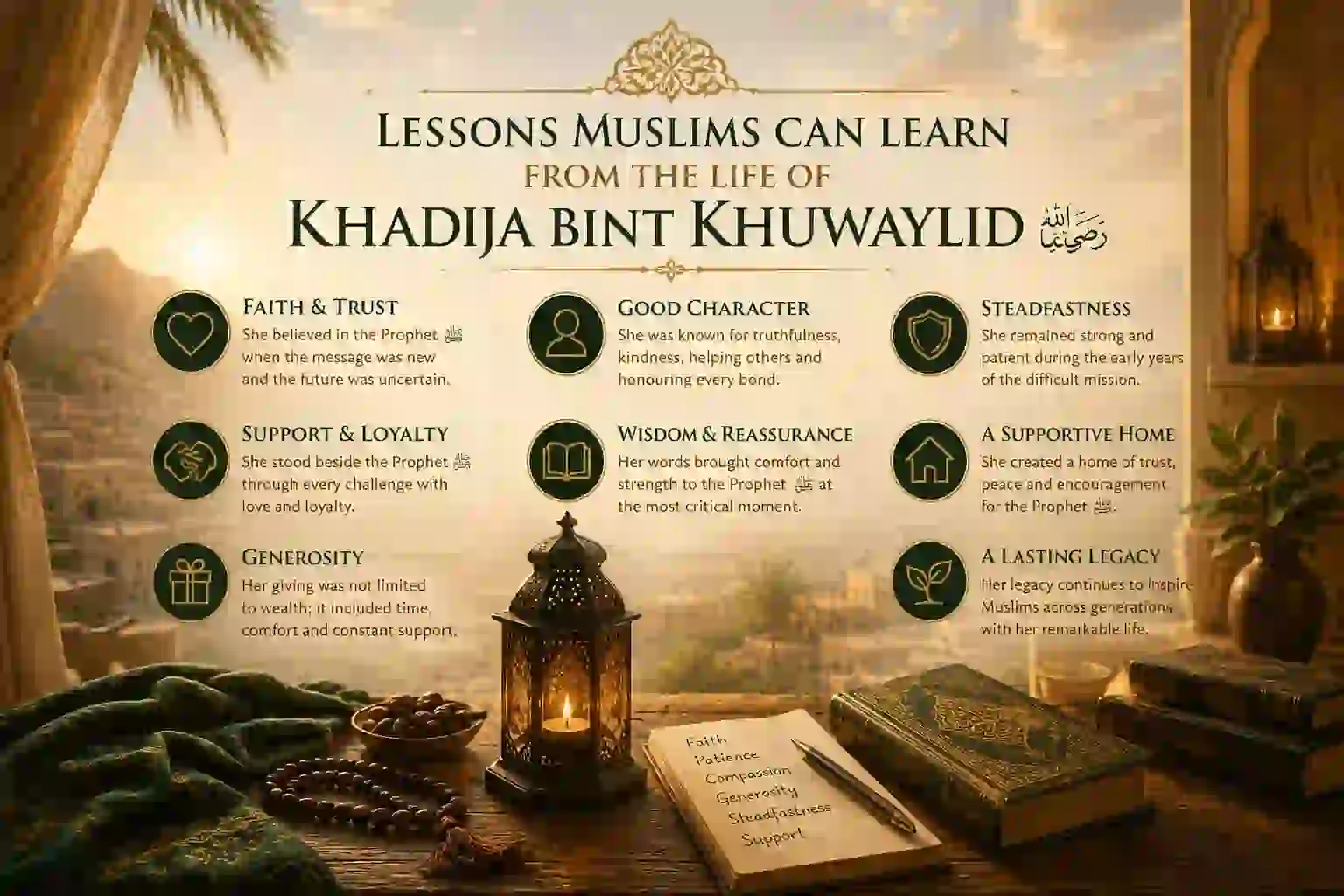
Generosity Is Broader Than Wealth
Historical sources describe Khadija رضي الله عنها as a woman of wealth and commercial standing. Her life with the Prophet ﷺ also included hardship and sacrifice.
Her example encourages a broader understanding of generosity.
Generosity can involve:
- Wealth
- Time
- Effort
- Knowledge
- Patience
- Emotional support
- Personal comfort
The important question Is not simply how much a person gives, but whether what they give is sincere and beneficial.
Islamic Knowledge Should Influence Character
Khadija’s words to the Prophet ﷺ focused on qualities that benefited other people: truthfulness, family ties, helping those in need, hospitality and supporting people facing hardship.
This gives us an important principle.
Islamic learning should not remain information alone.
Learning Quran and Islamic knowledge should gradually influence how a person speaks, behaves and treats others.
Studying the lives of the people who surrounded the Prophet ﷺ can therefore complement Quran learning and Islamic Studies.
A Supportive Home Can Strengthen a Difficult Journey
Khadija’s marriage to Prophet Muhammad ﷺ provides an important example of support within the home.
A family cannot remove every difficulty.
But it can become a place of trust, encouragement and reassurance.
Parents can encourage their children in Quran learning.
Spouses can support one another in worship and personal development.
Children can learn to become sources of kindness within their families.
A supportive home does not make every journey easy, but it can make difficult journeys easier to continue.
Consistency Is More Valuable Than Rushing
Khadija’s support was not limited to one moment.
Her importance is connected to her continued presence during the early years of the Prophet’s mission.
The same principle Is valuable in Quran learning.
A student does not build strong reading skills simply by attending one lesson. Progress develops through repeated practice, correction and revision.
For students studying Quran and Tajweed, a consistent learning routine can be more sustainable than setting unrealistic short-term targets.
Quran Imam’s guide to Quran Tajweed rules explains the importance of gradual correction and developing accurate recitation through structured learning.
Khadija’s Legacy
The legacy of Khadija رضي الله عنها is preserved through the authentic Sunnah as well as the historical record.
The Prophet ﷺ praised her virtues, remembered her frequently and continued to honour people who had been close to her.
Aisha رضي الله عنها reported that the Prophet ﷺ continued to mention Khadija after her death and that he would send gifts to her close friends.
Her legacy can therefore be seen through qualities such as:
- Faith
- Good character
- Patience
- Generosity
- Compassion
- Family support
- Steadfastness
These qualities do not belong to one generation.
They remain relevant to Muslims who are building families, raising children, studying Islam, learning Quran or trying to remain consistent in their worship.
Why Khadija Remains an Important Role Model
Khadija رضي الله عنها remains an important role model because her influence was not dependent on public recognition.
Khadija رضي الله عنها remains an important role model because her influence was not dependent on public recognition.
Her belief came when the message was still new.
Throughout the difficult years that followed, she supported the Messenger of Allah ﷺ when the path ahead was uncertain.
Even during hardship, she remained beside him with steadfastness and trust.
Long after her death, the Prophet ﷺ continued to remember her with affection and honour.
Her story encourages Muslims to consider the role they play in the lives of the people around them.
Are we people others can trust?
Do we support our families when life becomes difficult?
Do our beliefs influence our character?
And are we willing to remain consistent when something worthwhile requires patience?
These questions make the life of Khadija رضي الله عنها relevant far beyond the historical period in which she lived.
Frequently Asked Questions About Khadija bint Khuwaylid
Who was Khadija bint Khuwaylid?
Khadija bint Khuwaylid رضي الله عنها was the first wife of Prophet Muhammad ﷺ and one of the most honoured women in Islam. She was the first person to believe in his Prophethood according to the established accounts of the beginning of revelation and played an important role during the earliest period of Islam.
Was Khadija the first person to accept Islam?
Khadija رضي الله عنها is recognised by scholars of sīrah and Islamic history as the first person to believe in Prophet Muhammad ﷺ and his message. The authentic account of the first revelation describes her immediate support for him and her role in taking him to Waraqah ibn Nawfal.
Who did Khadija marry?
Khadija رضي الله عنها married Prophet Muhammad ﷺ before the beginning of his Prophethood. The well-known historical account states that he was twenty-five at the time of their marriage.
How old was Khadija when she married Prophet Muhammad ﷺ?
The commonly reported historical view is that Khadija رضي الله عنها was forty and Prophet Muhammad ﷺ was twenty-five. However, historical reports differ about her age, so forty should be understood as the commonly reported historical view rather than an undisputed fact.
How did Khadija support Prophet Muhammad ﷺ?
When the Prophet ﷺ returned after the first revelation, Khadija رضي الله عنها reassured him, reminded him of his good character and took him to Waraqah ibn Nawfal. This account is authentically reported in Sahih al-Bukhari.
What was Khadija known for?
Khadija رضي الله عنها was known for her faith, dignity, generosity and steadfast support for Prophet Muhammad ﷺ. Her virtues were also explicitly praised by the Prophet ﷺ in authentic hadith.
How many children did Khadija have with Prophet Muhammad ﷺ?
The recognised children of Khadija رضي الله عنها and Prophet Muhammad ﷺ were Al-Qasim, Abdullah, Zaynab, Ruqayyah, Umm Kulthum and Fatimah رضي الله عنهم. Ibrahim was born later to Maria al-Qibtiyya.
How long were Khadija and Prophet Muhammad ﷺ married?
They remained married until Khadija رضي الله عنها died. Their marriage began before revelation and continued through the earliest years of the Prophet’s mission. The Prophet ﷺ did not marry another woman while Khadija was alive.
What did Prophet Muhammad ﷺ say about Khadija?
The Prophet ﷺ described Khadija as the best woman of her time. Authentic narrations also record that she received glad tidings of a house in Paradise and that the Prophet ﷺ continued to remember her after her death.
Why is Khadija important in Islam?
Khadija رضي الله عنها is important because of her faith, character and support for Prophet Muhammad ﷺ during the earliest period of Islam. Her life also provides Muslims with an example of patience, generosity, compassion and steadfastness.
What can Muslims learn from Khadija?
Muslims can learn the importance of faith, good character, patience, generosity, family support and standing beside others during difficult times.
Conclusion
Khadija bint Khuwaylid رضي الله عنها occupies a unique place in Islamic history.
She was the first wife of Prophet Muhammad ﷺ and the first person to believe in his Prophethood. She stood beside him when the message was still new, supported him after the first revelation and remained with him during the difficult years in Makkah.
Her response to the first revelation demonstrates the value of trust, good character and reassurance. Her life also shows how patience, generosity and steadfast support can leave a lasting influence.
The Prophet ﷺ continued to remember Khadija with affection after her death, and authentic hadith record the special honour given to her.
Her story therefore remains relevant to Muslims today.
It reminds us that faith should influence character, that family support matters and that meaningful contributions are often built through patience and consistency.
For Muslims who want to deepen their understanding of the Quran and Islamic knowledge, studying the lives of the people who surrounded the Prophet ﷺ can provide valuable context for understanding the early history and values of Islam.
At Quran Imam, students can study Quran, Tajweed, Arabic and Islamic Studies through personalised one-to-one lessons with qualified teachers.
Ready to begin your Quran learning journey? Explore our Quran classes.
Book your free trial lesson and experience a lesson before deciding.

Sources and Further Reading
The core religious claims in this article should be supported by primary Islamic sources, particularly the authentic hadith collections.
Sahih al-Bukhari 4953 — The Beginning of Revelation
This narration covers the beginning of revelation, the Prophet’s ﷺ visits to the Cave of Hira, his return to Khadija رضي الله عنها and the encounter with Waraqah ibn Nawfal.
Sahih Muslim — The Beginning of Revelation
The beginning of revelation and the events surrounding the Prophet’s ﷺ experience are also reported through authentic narrations in Sahih Muslim.
Sahih al-Bukhari 3815 — The Virtue of Khadija
This narration records the Prophet’s ﷺ statement concerning the status of Khadija رضي الله عنها.
Sahih al-Bukhari 3818 — The Prophet’s Remembrance of Khadija
This narration records Aisha’s رضي الله عنها account of the Prophet ﷺ frequently mentioning Khadija and honouring her close friends.
Sahih al-Bukhari 3819–3820 — Glad Tidings of Paradise
These narrations record the glad tidings given to Khadija رضي الله عنها of a house in Paradise and the greeting conveyed to her from Allah.
Historical details that are not established by authentic hadith should be treated as sīrah or historical reports rather than presented with the same certainty as authenticated Prophetic narrations.