


Quran Tajweed Rules help Muslims recite the Quran correctly and preserve the proper pronunciation of every letter and word. For many beginners, especially non-Arabic speakers, Tajweed may seem difficult at first because it introduces new pronunciation rules and Arabic sounds that may not exist in their native language.
Many Muslims dream of reciting the Quran beautifully and accurately, but terms such as Makharij, Qalqalah, and Madd can feel overwhelming when encountered for the first time. For many non-Arabic speakers in the UK, learning Tajweed can be even more challenging because certain Arabic sounds have no direct equivalent in English.
In our online lessons, many beginners initially worry about mispronouncing letters or making mistakes while reciting in front of a teacher. With patient correction, structured guidance, and regular practice, this confidence usually improves over time.
The good news is that Tajweed is not as complicated as many people think. With the right teacher, consistent practice, and a step-by-step approach, students can steadily improve their Quran recitation.
At Quran Imam, we help children and adults learn Quran Tajweed Rules through personalised one-to-one online lessons with qualified Al-Azhar teachers, making Tajweed accessible for complete beginners and more advanced learners alike.
What Are Quran Tajweed Rules?
Quran Tajweed Rules are a set of guidelines that help Muslims recite the Quran correctly, exactly as it was taught by Prophet Muhammad ﷺ.
The word “Tajweed” comes from the Arabic word meaning “to improve” or “to make better.” In Quran recitation, Tajweed refers to pronouncing every letter from its correct point of articulation while giving each letter its rights and characteristics
Learning Tajweed helps students:
• Pronounce Arabic letters correctly
• Avoid common recitation mistakes
• Improve fluency and confidence
• Preserve the original pronunciation of the Quran
• Beautify Quran recitation
Without Tajweed, students may unintentionally change the pronunciation or meaning of Quranic words.
How to Read Quran for Beginners
Why Are Quran Tajweed Rules Important?
Tajweed is not simply about making the Quran sound beautiful. It helps preserve the words of Allah exactly as they were revealed.
When students learn Quran Tajweed Rules, they develop better pronunciation, stronger confidence, and a deeper connection with the Quran.
For non-Arabic speakers, Tajweed is particularly important because many Arabic sounds have no equivalent in English. Learning these sounds correctly from the beginning prevents mistakes from becoming long-term habits.
The Most Important Quran Tajweed Rules for Beginners
Beginners do not need to learn every Tajweed rule at once. Most students start by focusing on the core rules that have the greatest impact on recitation.
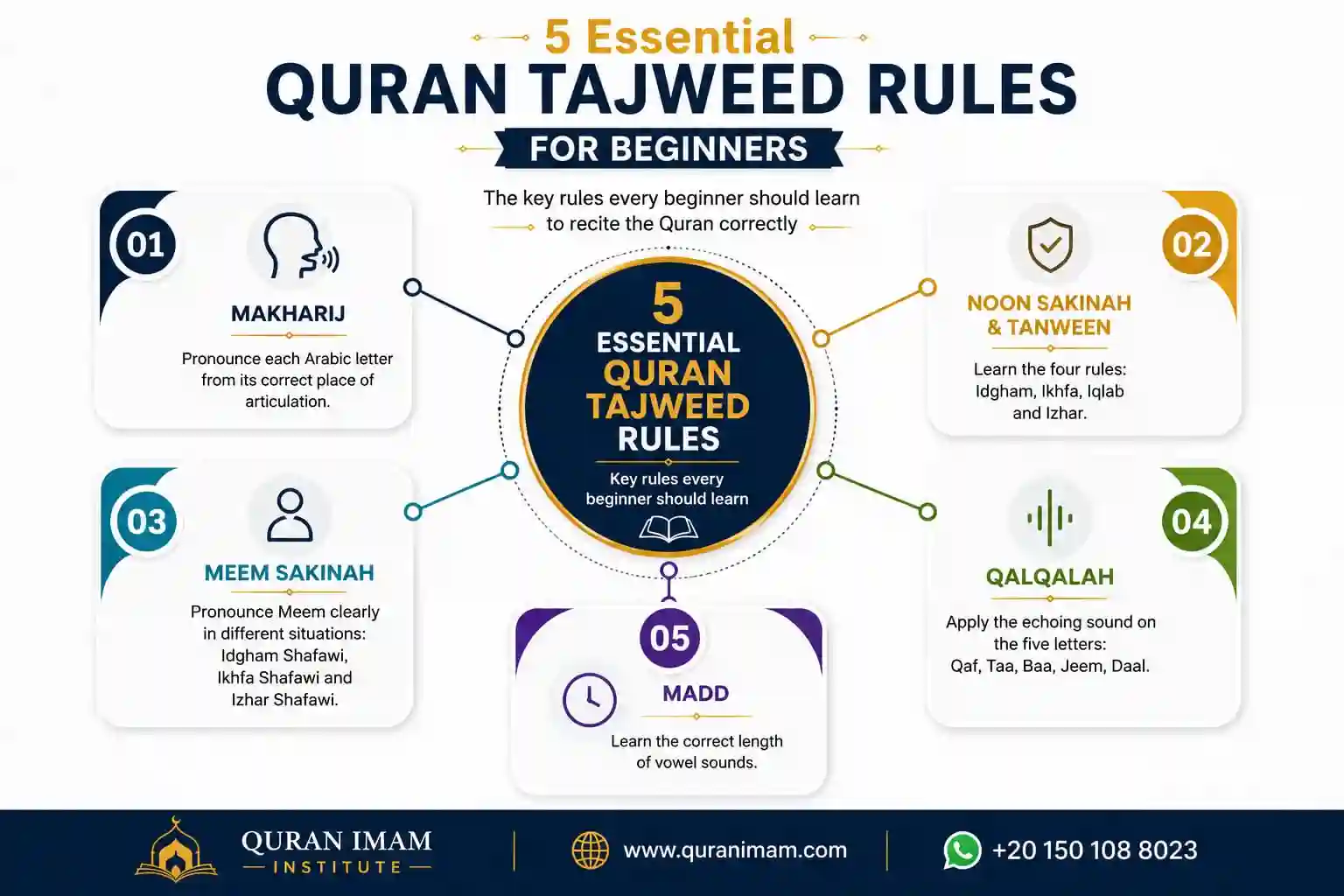
Makharij (Points of Articulation)
Makharij refers to the correct place from which each Arabic letter is pronounced.
This is often the biggest challenge for students learning Quran Tajweed Rules, especially when pronouncing letters such as:
• ع (Ayn)
• ح (Haa)
• خ (Khaa)
• ق (Qaaf)
Learning these sounds correctly requires practice, listening, and direct correction from a qualified teacher.
Noon Sakinah and Tanween
These rules determine how the letter Noon is pronounced depending on the letters that follow it.
Students learn concepts such as:
• Idgham
• Ikhfa
• Iqlab
• Izhar
These rules improve fluency and make Quran recitation more natural
Meem Sakinah
Meem Sakinah rules teach students how to pronounce the letter Meem correctly in different situations.
Although simpler than some other Tajweed topics, they play an important role in clear recitation
Qalqalah
Qalqalah creates a slight echoing sound on specific letters when they carry Sukoon.
The letters are: (ق ط ب ج د)
Mastering Qalqalah helps students sound more accurate and confident when reciting the Quran.
Madd (Elongation)
Madd refers to extending certain vowel sounds for a specific number of counts.
Many beginners either shorten Madd too much or extend it incorrectly. Learning the correct lengths helps students recite more naturally and accurately.
Book Your Free Trial Tajweed Lesson Today
Common Tajweed Mistakes Non-Arabic Speakers Make
Through our experience teaching students across the UK, we regularly notice several common challenges.
Difficulty Pronouncing Arabic Letters
One of the biggest challenges for beginners is pronouncing Arabic sounds that do not exist in English.
Letters such as ع, ح, خ, and ق often require additional practice before students feel comfortable using them correctly.
Confusing Similar Letters
Some beginners confuse letters that sound similar, such as:
• س and ص
• ت and ط
• د and ض
Without proper guidance, these mistakes can continue for a long time.
Incorrect Madd Lengths
One common Tajweed mistake is giving incorrect length to elongated sounds.
Consistent correction helps students develop a natural rhythm in their recitation.
Can You Learn Quran Tajweed Rules Online?
Yes, Online learning has made Quran education more accessible than ever.
With live one-to-one lessons, students can receive immediate correction, personalised feedback, and structured guidance without leaving home.
Many families in the UK now prefer online Quran learning because it offers:
• Flexible scheduling
• Individual attention
• Convenient home learning
• Access to qualified teachers
For many students, online Tajweed lessons are just as effective as traditional face-to-face learning.
How Long Does It Take to Learn Quran Tajweed Rules?
The answer depends on the student’s starting level, learning goals, and consistency.
Most beginners start noticing improvements within a few weeks when they practise regularly and attend lessons consistently.
From our experience at Quran Imam, students who attend regular one-to-one lessons often make steady progress because teachers can focus directly on their pronunciation and recitation needs.
The goal is not to learn every rule quickly but to apply them correctly over time.
1-to-1 Online Quran Classes in London with Native Egyptian Tutors
Why Many UK Students Struggle with Tajweed?
Many Muslims in the UK grow up speaking English as their first language, which can make Arabic pronunciation feel unfamiliar, especially for beginners with little or no Arabic background.
From our experience teaching non-Arabic speakers, pronunciation is only one part of the challenge. Many students initially lack confidence when reading aloud because they are afraid of making mistakes. Others struggle to distinguish between similar Arabic letters or become frustrated when they cannot immediately produce sounds such as ع, ح, خ, or ق correctly.
Consistency is another common obstacle. Adult learners often balance work and family commitments, while children may require regular encouragement from parents to practise between lessons. Students who attend lessons consistently and review their teacher’s corrections usually make stronger long-term progress than those who practise irregularly.
This is one reason why personalised one-to-one learning often produces better results than larger group classes, as teachers can focus on each student’s specific pronunciation and recitation challenges.
Tips for Learning Quran Tajweed Rules More Effectively
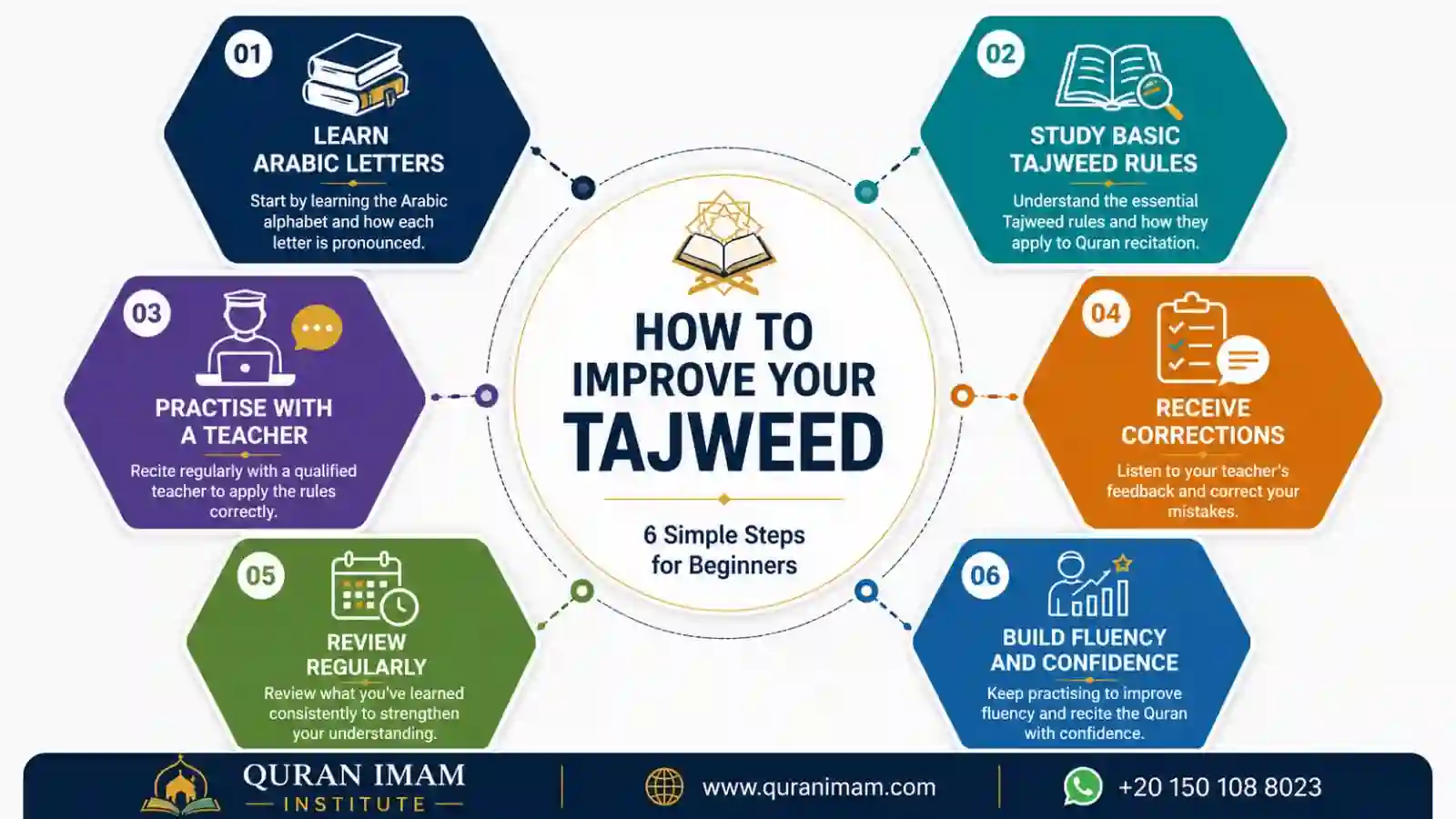
Learning Quran Tajweed Rules does not require memorising every rule at once. Most students make better progress when they focus on consistent practice and gradual improvement.
A few practical tips include:
• Regular daily Quran recitation, even for a few minutes, can make a significant difference.
• Students often make faster progress when they master one Tajweed rule before moving to the next.
• Careful listening to qualified Quran reciters helps improve pronunciation and fluency.
• Previous corrections should be reviewed regularly rather than focusing only on new material.
• Reading aloud during lessons allows teachers to identify and correct mistakes more effectively.
Students are often surprised by how much their recitation improves when they combine regular practice with personalised feedback from a qualified teacher.
How Quran Imam Helps Students Master Tajweed
At Quran Imam, we focus on helping students build strong Tajweed foundations through personalised learning.
What makes Quran Imam different?
- One-to-One Lessons Only
- Qualified Al-Azhar Teachers
- Strong Academic and Islamic Background
- Flexible Scheduling
- Child-Friendly Learning Methods
- Regular Communication with Parents
- Affordable Fees
- Free Trial Lesson
Our teachers understand the challenges faced by non-Arabic speakers and provide step-by-step guidance to help students improve confidently.

Frequently Asked Questions About Quran Tajweed Rules
What are Quran Tajweed Rules?
Quran Tajweed Rules are guidelines that help Muslims pronounce Quranic letters and words correctly during recitation.
Can I learn Tajweed as a complete beginner?
Yes. Most students begin with no previous knowledge and gradually learn Tajweed step by step.
Why is Tajweed important?
Tajweed helps preserve the correct pronunciation of the Quran and reduces recitation mistakes.
How long does it take to learn Tajweed?
This depends on your level and consistency, but most students notice improvement within a few weeks of regular practice.
Can children learn Tajweed online?
Absolutely. Many children successfully learn Tajweed through personalised online lessons with qualified teachers.
Do I need a teacher to learn Tajweed?
While self-study can help, learning with a qualified teacher provides direct correction and significantly improves accuracy.
Learn Quran Online Skype: Personalised Quran Lessons for Kids and Adults in the UK

Book Your Free Trial Tajweed Lesson Today
Learning Quran Tajweed Rules is one of the most rewarding steps you can take to improve your Quran recitation and strengthen your connection with the words of Allah.
Every student starts somewhere. Whether you are learning Tajweed for the first time or helping your child build a stronger connection with the Quran, our teachers are ready to guide you step by step.
At Quran Imam, our qualified Al-Azhar teachers provide personalised one-to-one online Tajweed lessons for children and adults across the UK.
Whether you are a complete beginner or looking to refine your recitation, we are here to support your journey.
Book Your Free Trial Tajweed Lesson today and discover how personalised Quran learning can help you recite the Quran with confidence and accuracy.