


What Is Al Quran Tajweed?
Reading the Quran correctly is about more than recognising Arabic letters. For many non-Arabic-speaking Muslims, learning Al Quran Tajweed is an important step towards understanding how each letter should sound, when a sound should be extended, how certain letters are pronounced, and where to stop and start during recitation.
This is where Al Quran Tajweed becomes important.
Al Quran Tajweed refers to the principles and rules used to recite the Quran accurately, giving Arabic letters their correct pronunciation and characteristics.
Tajweed helps learners:
- Pronounce Arabic letters from their correct articulation points.
- Distinguish between similar sounds.
- Apply appropriate elongation rules.
- Understand relevant rules of Noon Saakin, Tanween and Meem Saakin.
- Apply Qalqalah and other pronunciation rules.
- Recognise appropriate stopping and starting points.
- Develop more accurate and confident Quran recitation.
Tajweed is a practical skill. It needs to be heard, corrected and practised.
Reading about a rule can help you understand it, but a qualified teacher can listen to your recitation and identify mistakes that you may not notice yourself.
If you are completely new to Quran reading, our guide to [How to Read Quran for Beginners] can help you understand the foundations that come before and alongside Tajweed.
Why Is Tajweed Important When Reading the Quran?
Arabic contains sounds that can be unfamiliar to people who did not grow up speaking the language.
Two letters may look or sound similar to a beginner while requiring noticeably different pronunciation.
For example, students may struggle to distinguish between:
- س and ص
- ت and ط
- د and ض
Other Arabic sounds can be particularly challenging for non-Arabic speakers, including:
- ع
- غ
- ح
- خ
- ق
A student may understand what a letter looks like but still struggle to pronounce it correctly.
Often, they need to hear the correct sound, understand how it is produced, practise it repeatedly and receive individual correction.
That is one reason Quran recitation with Tajweed is much more than learning definitions from a book.
For students who want structured guidance, [Quran Recitation with Tajweed Rules] provides a focused path for developing accurate Quran recitation.
Tajweed Rules for Beginners: Where Should You Start?
Beginners often see a long list of Tajweed terminology and wonder where they should begin.
A practical starting point Is to build the foundations first and then gradually introduce the main Tajweed rules.
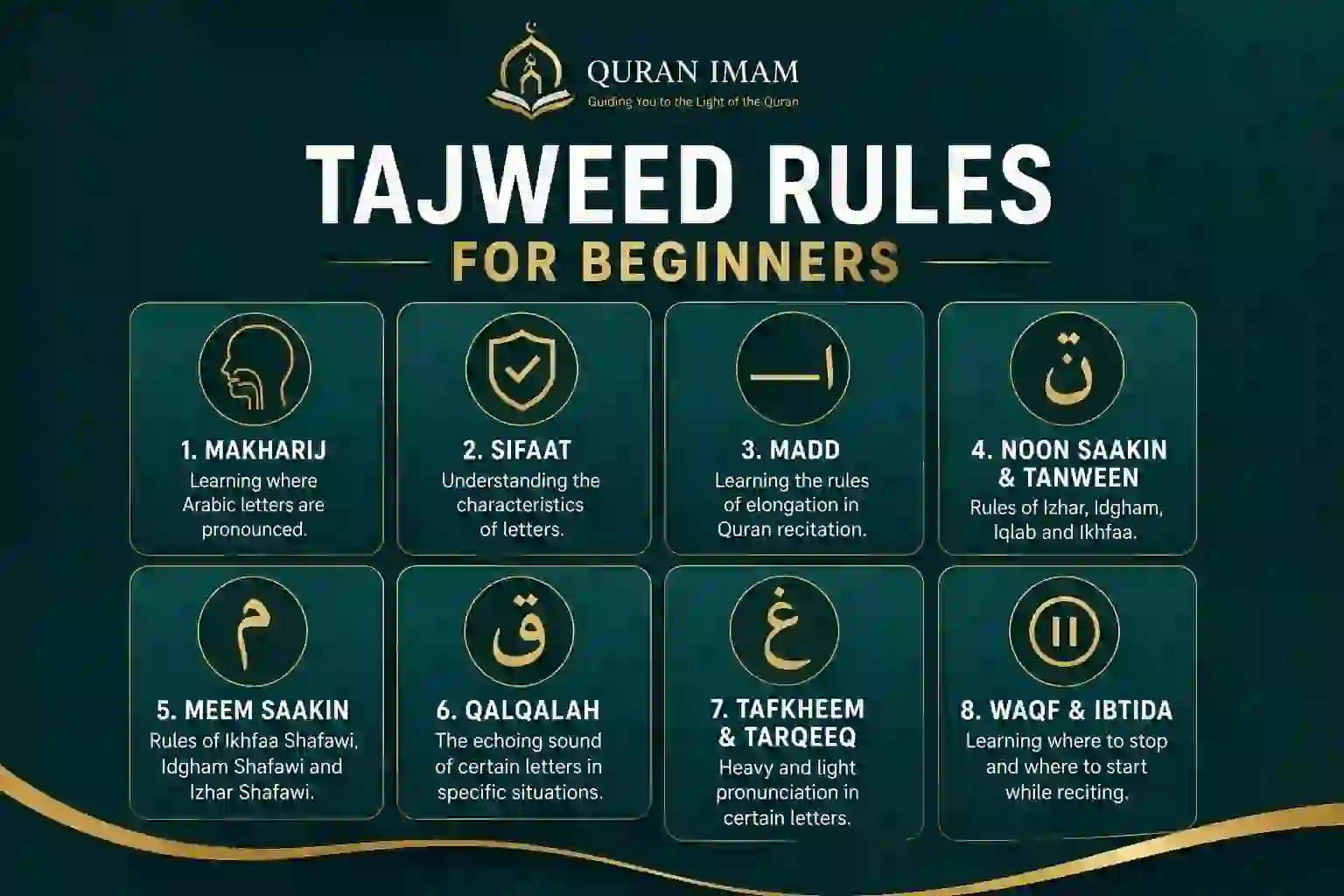
Start With Arabic Letters
Learn to recognise the Arabic letters and produce their basic sounds correctly.
If you are still developing your Arabic reading skills, [Learn How to Read Arabic] can help you build this foundation.
Learn Makharij
Once you recognise the letters, focus on where each letter is articulated and how its sound is produced.
Understand Letter Characteristics
Learning the characteristics of Arabic letters can help you distinguish between sounds that may initially seem similar.
Learn Madd
Gradually learn when sounds should be extended and how different types of Madd are applied during Quran recitation.
Learn Noon Saakin and Tanween
Beginners gradually encounter rules such as Izhar, Idgham, Iqlab and Ikhfaa.
Learn Meem Saakin Rules
Students also learn how Meem Saakin is pronounced in different situations, including Ikhfaa Shafawi, Idgham Shafawi and Izhar Shafawi.
Practise Qalqalah
Learn how the relevant letters are pronounced when Qalqalah applies, while avoiding excessive or weak pronunciation.
Learn Tafkheem and Tarqeeq
Understand the difference between heavier and lighter pronunciation and how these qualities affect certain letters.
Develop Waqf and Ibtida
As your reading improves, learn how to stop and restart appropriately during Quran recitation.
The exact order does not have to be identical for every learner.
Someone who cannot yet read Arabic will need a different starting point from someone who already reads the Quran but wants to improve their Tajweed.
The Main Areas of Al Quran Tajweed
1. Makharij: Learning Where Arabic Letters Are Pronounced
Makharij al-Huruf refers to the articulation points of Arabic letters.
For beginners, this is one of the most important foundations of Quran recitation.
A student might recognise the letter ق, for example, but produce a sound that is closer to another Arabic letter because they have not yet learned how to position the relevant part of the mouth or tongue.
The same applies to difficult throat sounds such as ع، ح، خ and غ.
A teacher can demonstrate the pronunciation, listen to the learner’s attempt and make small corrections until the sound becomes more accurate.
This is difficult to achieve through written explanations alone.
For a broader introduction to learning Quran reading, see [How to Read Quran for Beginners].
2. Sifaat: Understanding the Characteristics of Letters
Arabic letters have different characteristics that affect how they are pronounced.
Learning these characteristics helps students distinguish between sounds that may initially seem very similar.
This can be particularly useful when a learner confuses:
- س / ص
- ت / ط
- د / ض
Recognising the letters visually is only the first step.
The learner also needs to develop an accurate sound for each one.
Regular guided recitation gives the teacher opportunities to identify these differences and correct them.
3. Madd: Learning Quranic Elongation
Madd refers to elongation during Quranic recitation.
One common beginner difficulty is knowing how long a sound should be extended.
A student might:
- Make an elongation too short.
- Make it too long.
- Treat different types of Madd in the same way.
- Apply the rule inconsistently.
This is a good example of why Tajweed should not be treated as theory alone.
The student needs to hear the correct recitation and practise applying the rule while reading.
4. Noon Saakin and Tanween
Another important area of Tajweed involves Noon Saakin and Tanween.
Depending on the letter that follows, different pronunciation rules apply.
Beginners gradually encounter rules such as:
- Izhar
- Idgham
- Iqlab
- Ikhfaa
The terminology may initially seem complicated.
A teacher can make It easier by introducing one rule at a time and immediately showing the student how it appears during Quran reading.
For a deeper explanation of these areas, see our guide to [Quran Tajweed Rules].
5. Meem Saakin Rules
Students also learn how Meem Saakin is pronounced in different circumstances.
The main rules Include:
- Ikhfaa Shafawi
- Idgham Shafawi
- Izhar Shafawi
The objective is not simply to memorise the names.
The learner needs to recognise the situation while reading and produce the correct sound naturally.
6. Qalqalah
Qalqalah describes a characteristic echoing quality associated with certain letters in relevant situations.
Beginners can sometimes struggle in two opposite ways.
They may produce the sound too weakly, or they may exaggerate it and add an unnecessary vowel-like sound.
Listening to a qualified teacher and repeating the sound carefully can help the learner develop better control.
7. Tafkheem and Tarqeeq: Heavy and Light Pronunciation
Some Arabic letters are pronounced with a heavier quality, while others are lighter.
These concepts are known as:
- Tafkheem
- Tarqeeq
Certain letters, including ر, can require additional attention depending on the situation.
This is another area where practical listening and correction can make a noticeable difference.
8. Waqf and Ibtida: Stopping and Starting
Good Quran recitation is not only about pronouncing individual letters and words.
Students also need to learn how to stop and restart appropriately.
This is known as Waqf and Ibtida.
Stopping at an unsuitable point can affect the flow of the recitation and, in some cases, the intended meaning.
As students become more advanced, they can gradually develop a better understanding of appropriate stopping and starting points.
A Simple Al Quran Tajweed Learning Path
Learning Tajweed does not have to feel like memorising a large textbook.
Many beginners progress through a gradual process.
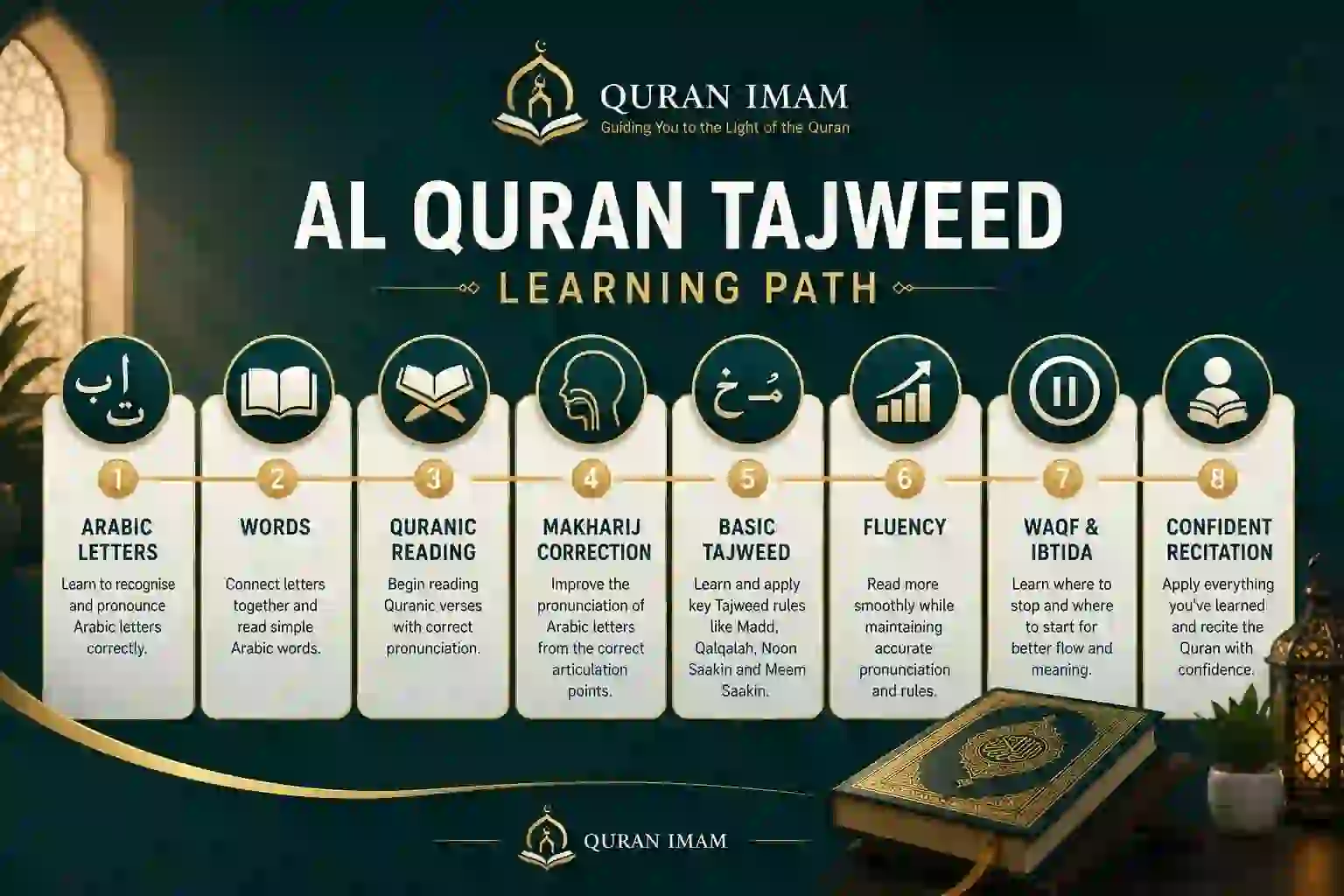
Stage 1 – Arabic Letters
Recognising the letters and learning their basic sounds.
Stage 2 – Words
Beginning to connect letters and read simple Arabic words.
Stage 3 – Connected Quranic Reading
Moving from individual words towards connected verses.
Stage 4 – Makharij Correction
Improving the pronunciation of difficult Arabic letters.
Stage 5 – Basic Tajweed
Gradually applying rules such as Madd, Qalqalah and relevant Noon Saakin and Meem Saakin rules.
Stage 6 – Fluency
Reading more smoothly while maintaining accurate pronunciation.
Stage 7 – Waqf and Ibtida
Learning to stop and restart appropriately.
Stage 8 – Confident Quran Reading
Applying the learned principles more naturally while reading complete Quran pages.
Not every learner follows exactly this progression.
Some students develop memorisation skills quickly. Others develop reading ability first.
The teaching approach should adapt to the learner rather than forcing every student into the same timeline.
Common Tajweed Difficulties We See in Beginners
Every student is different, but several difficulties appear repeatedly in our teaching experience.
Slow Quran Reading
Beginners may read very slowly because they are concentrating on individual letters and sounds.
This is normal during the early stages.
Speed should not be the first goal.
Accuracy comes before speed. Fluency can develop gradually as the learner becomes more familiar with the letters, words and Tajweed rules.
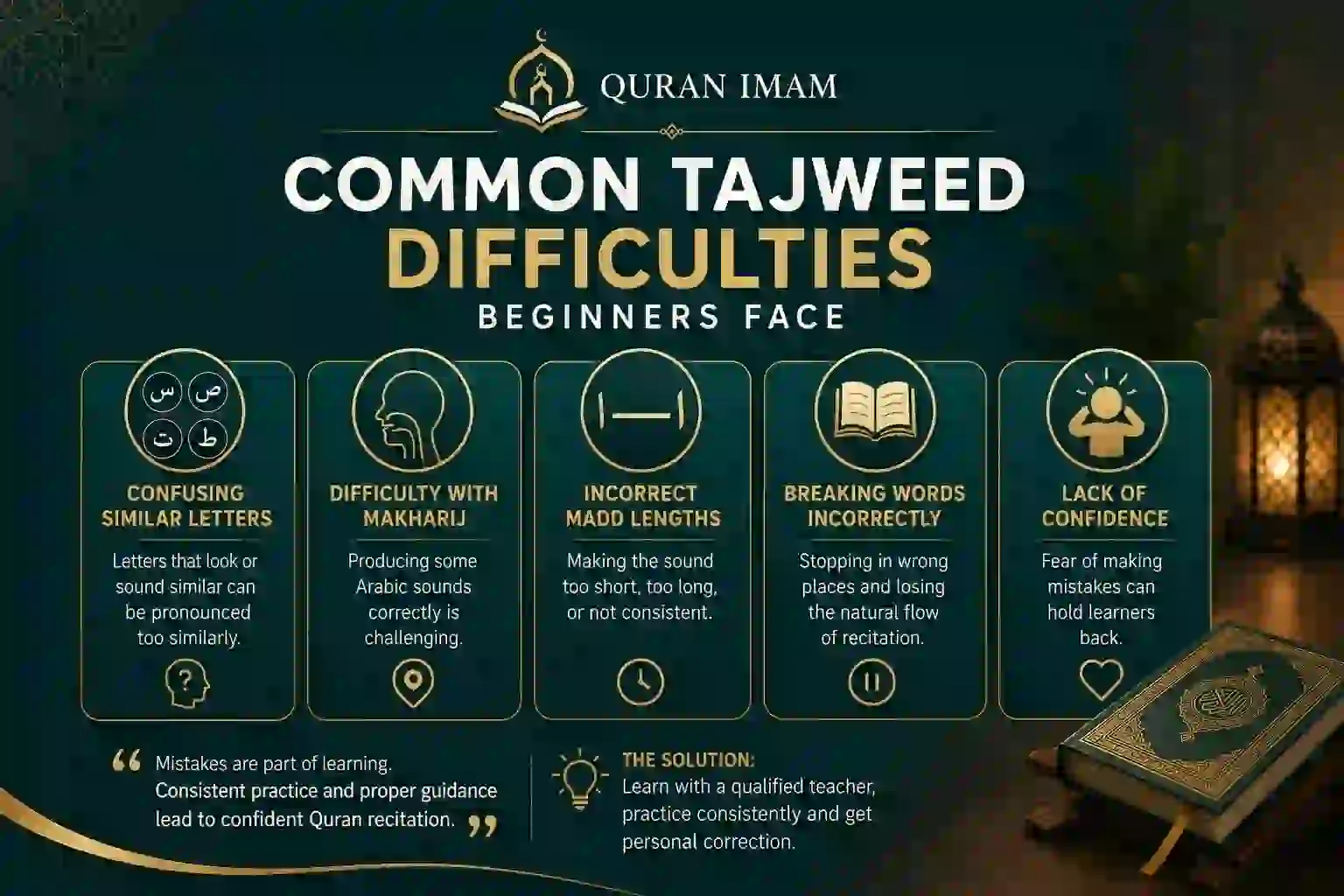
Confusing Similar Letters
Students may recognise the written letters but pronounce them too similarly.
Common examples include:
- س / ص
- ت / ط
- د / ض
Repeated comparison, listening and correction can help establish clearer distinctions.
Difficulty With Makharij
Some Arabic sounds require movements that are unfamiliar to non-Arabic speakers.
The learner may understand the explanation but still need repeated practice before the sound becomes natural.
Incorrect Madd Lengths
Students may extend sounds inconsistently.
Regular correction helps them become more aware of the required elongation while reading.
Breaking Words Incorrectly
Beginners sometimes pause between connected parts of a word or read in a way that affects the natural flow.
This generally improves with guided reading and practice.
Fear of Reading Aloud
Some learners become nervous because they know they make mistakes.
A good learning environment should make correction feel normal.
Mistakes are not evidence that a student cannot learn.
They are information that tells the teacher what to work on next.
Why Al Quran Tajweed Should Be Practised, Not Just Memorised
One of the most important lessons we have seen through teaching is this:
Knowing a Tajweed rule does not automatically mean you can apply it correctly.
A student may be able to explain what Madd means but still use the wrong length while reading.
They may know that two letters are different but pronounce them almost identically.
That is why practical correction matters.
A one-to-one lesson might involve:
- Reviewing previously learned material.
- Listening to the student’s recitation.
- Identifying specific mistakes.
- Explaining the relevant rule.
- Demonstrating the correct pronunciation.
- Asking the student to repeat it.
- Applying the correction to Quranic reading.
- Revisiting the mistake later to check retention.
This turns Tajweed from something the learner knows about into something they can actually use.
Students who need individual attention may also benefit from working with a [Private Quran Tutor].

Ready to Start Learning Al Quran Tajweed?
You do not need to know every Tajweed rule before beginning.
If you are starting from the Arabic alphabet, already reading the Quran, or simply want to correct recurring pronunciation mistakes, the right starting point depends on your current level.
At Quran Imam, one-to-one lessons allow a qualified teacher to listen to your recitation, identify your specific needs and guide you through Tajweed gradually.
Can Beginners Learn Tajweed?
Yes.
The important question Is not whether you are a complete beginner.
It is where you should start.
Someone who cannot recognise Arabic letters may need to begin with the Arabic alphabet and basic reading.
Someone who can already read the Quran may need to focus on:
- Makharij
- Madd
- Similar letters
- Fluency
- Waqf and Ibtida
- Other Tajweed rules
At Quran Imam, we do not expect every student to start from the same place.
A personalised learning plan allows the teacher to identify the learner’s current level and focus on the areas that need the most attention.
Students who need a broader introduction to online Quran learning can also explore our [Online Quran Academy for Non Arabic Speaking].
Can I Learn Tajweed Without Speaking Arabic?
Yes.
You do not need to speak Arabic fluently before learning Quranic recitation and Tajweed.
Many Muslims who do not speak Arabic learn to read the Quran with appropriate pronunciation through structured lessons and regular practice.
However, Tajweed and Arabic language learning are not the same thing.
Tajweed focuses on accurate Quranic recitation.
Arabic language learning is broader and can include:
- Vocabulary
- Grammar
- Speaking
- Listening
- Reading
- Writing
- Comprehension
The two subjects can complement each other, but learning one does not automatically mean you have mastered the other.
If your goal includes understanding the meaning of the Quran as well as improving recitation, our [Quranic Arabic Course] can be a useful complementary option.
How Long Does It Take to Learn Tajweed?
There is no fixed timeline that applies to every learner.
Progress can depend on:
- Starting level
- Age
- Lesson frequency
- Attendance
- Home practice
- Revision
- Individual learning ability
- Teacher guidance
- Long-term consistency
Based on our teaching experience, some beginners who start without Arabic reading ability and attend around three lessons per week, while also revising at home, have been able to progress to reading from the Mushaf after approximately three months.
This is an experience-based benchmark, not a guaranteed result.
Some students progress more quickly.
Others need considerably longer.
The aim should not be to reach a particular stage by a fixed date.
The more useful goal Is to develop accurate reading habits that can continue over time.
If you are also learning Arabic alongside Quran reading, our guide on [How Long Does It Take to Learn Arabic] may be useful.
What Does a One-to-One Tajweed Lesson Look Like?
A practical Tajweed lesson should give the learner plenty of opportunities to recite.
A typical lesson may include:
1. Revision
The student revisits material from previous lessons.
2. Recitation
The teacher listens carefully while the student reads.
3. Correction
Specific pronunciation and Tajweed mistakes are identified.
4. Explanation
The teacher explains the rule in a way appropriate to the student’s level.
5. Guided Practice
The student repeats the difficult sound, word or passage.
6. Quran Application
The learner applies the correction while reading from the Quran.
7. Review
The teacher checks whether the learner can apply the correction independently.
This approach is particularly useful because the lesson can change according to the student’s needs.
Why One-to-One Tajweed Lessons Can Help
Tajweed involves skills that are highly individual.
Two students may know the same rule but have completely different pronunciation problems.
One learner may struggle with ق.
Another may confuse س and ص.
Another may read accurately but struggle with Madd.
In a one-to-one lesson, the teacher can focus on the learner’s specific needs.
This allows for:
- Immediate pronunciation correction
- Personalised lesson pacing
- Repetition of difficult sounds
- Individual feedback
- Targeted revision
- Suitable Quran passages
- Progress tracking
- A learning plan adapted to the student’s level
The aim is not simply to complete lessons.
It is to help the student gradually become more accurate and confident.
Learning Tajweed for Children
Children do not all learn Quran in the same way.
Some respond particularly well to structured reading instruction.
Others have strong listening and memorisation abilities and may learn through repetition before becoming confident readers.
This is why teaching should be adapted to the child.
A child struggling with reading speed may need more guided reading.
Another may need additional work on Makharij.
Another may understand the lesson but need encouragement to read aloud without fear of mistakes.
For parents, progress should therefore be measured by more than the number of pages completed.
Useful signs include:
- Better Arabic letter recognition
- Clearer pronunciation
- Fewer repeated mistakes
- Improved fluency
- Greater confidence
- Better application of Tajweed rules
- Stronger revision habits
Parents looking specifically for children’s Quran learning can explore [Learn Quran for Kids].
Learning Tajweed for Adults
It is never too late to improve your Quran recitation.
Adults sometimes worry that they have started too late or that learning Arabic pronunciation will be too difficult.
Our teaching experience includes adults who began without Arabic reading ability and gradually developed confident Quran reading through consistent lessons.
For many adults, the biggest challenge is not age.
It is finding a learning routine they can maintain alongside work and family responsibilities.
A realistic schedule that can be followed consistently is often more useful than an intensive schedule that becomes difficult to sustain.
Learning Tajweed Around Work, School and Family Life in the UK
For Muslims living in the UK, Quran learning often needs to fit around school, work and family commitments.
Children may have school during the day and activities after school.
Adults may work full-time or have family responsibilities in the evening.
This is one reason online one-to-one lessons can be practical for many families.
There is no need to travel to a physical classroom for every lesson, and scheduling can be arranged around the learner’s routine.
The important thing Is to choose a schedule that is realistic enough to maintain.
Consistency matters more than simply booking a large number of lessons.
For families looking for a qualified [Quran Teacher in the UK], it is useful to consider the teacher’s qualifications, teaching approach, availability and experience with learners at your level.
How to Practise Tajweed at Home
Your lesson is only part of the learning process.
Regular practice between lessons can help reinforce what you have learned.
1. Read the Same Passage More Than Once
Repetition helps you become familiar with the pronunciation and rules.
2. Work on One Correction at a Time
If your teacher identifies a particular Makharij problem, focus on that correction instead of trying to fix every mistake at once.
3. Listen Carefully
Listening to accurate Quran recitation can help you become more aware of pronunciation, elongation and the flow of recitation.
4. Revise Previous Lessons
Do not focus only on new material.
Revision helps protect previously learned corrections from being forgotten.
5. Practise Consistently
A short, focused practice session that you can maintain regularly may be more useful than a long session once a week.
Common Mistakes Students Make When Learning Tajweed
Trying to Learn Everything at Once
Tajweed contains many concepts.
Trying to memorise every rule immediately can make the subject feel unnecessarily difficult.
Learn progressively.
Focusing on Speed
Reading quickly does not necessarily mean reading correctly.
Accuracy should come first.
Fluency develops with practice.
Learning Theory Without Application
Knowing a definition does not guarantee correct recitation.
The rule needs to be applied while reading.
Avoiding Correction
Some learners feel embarrassed when corrected.
But correction is one of the most valuable parts of Tajweed learning.
A mistake identified today gives you something specific to improve.
Neglecting Revision
Learning new material without revisiting previous corrections can lead to old mistakes returning.
At Quran Imam, we view revision as part of learning rather than an optional extra.
What Real Student Progress Can Look Like
Student progress does not always look the same.
One learner may improve pronunciation first.
Another may become fluent in reading.
Another may develop strong memorisation skills before becoming a confident reader.
Our student experiences illustrate this variety.
Haroon
Haroon began with slow Quran recitation, clear Makharij mistakes, difficulty distinguishing Madd lengths and problems with Waqf and Ibtida.
After approximately six months of learning, he had nearly completed his Quran recitation, with significant improvements in fluency, Makharij, Madd application and stopping and starting.
Ali, Age 42
Ali began without Arabic reading ability.
After approximately one year of consistent learning, he was able to read a complete page of the Quran confidently in under five minutes.
Ali Louhichi, Age 26
Ali Louhichi also began without Arabic reading ability.
After approximately seven months, he was able to read a complete Quran page confidently in under eight minutes.
Muhammad Shahid, Age 10
Muhammad Shahid began without Arabic reading ability.
After approximately one year, he was able to read a complete page of the Quran confidently in under four minutes.
These are examples of individual student journeys from our teaching experience.
They are not guaranteed timelines or expected results for every learner.
Progress depends on factors including attendance, lesson frequency, home practice, revision, individual ability and commitment.
How Do You Know If Your Tajweed Is Improving?
Progress can be seen in several practical ways.
You may notice that:
- You make fewer repeated pronunciation mistakes.
- Difficult Arabic letters become easier to pronounce.
- Your Madd becomes more consistent.
- You recognise Tajweed rules while reading.
- You break words less often.
- Your reading becomes smoother.
- You feel more comfortable reciting aloud.
- You can apply corrections with less prompting.
A teacher’s feedback Is also important because some pronunciation errors are difficult to hear in your own recitation.
Progress is not always measured by reading faster.
Sometimes improvement means that a difficult letter has become more accurate, a repeated mistake has disappeared, or the learner can apply a Tajweed rule without being reminded.
Should You Learn Tajweed Before Memorising the Quran?
Correct recitation should be part of Quran memorisation from the beginning.
If a student repeatedly memorises a passage with incorrect pronunciation, correcting the same mistake later may become more difficult.
This is why effective Hifz learning needs more than new memorisation.
It should include:
- Correct recitation
- New memorisation
- Regular revision
- Teacher correction
- Home practice
At Quran Imam, one of our central principles is:
- Revision is part of memorisation.
- The goal is not simply to increase the amount memorised.
- The goal is to retain It accurately and confidently over time.
- Students interested in structured memorisation can explore [Quran Memorization].
Is Online Tajweed Learning Effective?
Online Tajweed learning can be effective when it involves live, personalised teaching rather than simply watching pre-recorded material.
The teacher needs to hear the student’s actual recitation.
During a live lesson, the teacher can listen for:
- Pronunciation
- Makharij
- Madd
- Fluency
- Application of Tajweed rules
- Repeated mistakes
They can then correct the student immediately.
For families in the UK, online learning can also make Quran lessons easier to fit around school, work and family routines.
However, online learning is not automatically effective simply because it takes place online.
The quality of teaching, student participation and consistency all matter.
Families comparing different learning options may also find our [Best Online Quran Classes Reviews] guide useful.
How Quran Imam Approaches Al Quran Tajweed
At Quran Imam, we believe Tajweed should be taught as a practical Quran-reading skill rather than as a list of rules to memorise.
Our one-to-one lessons are adapted to the learner’s starting level.
A complete beginner may begin with Arabic letters and foundational reading.
A student who already reads the Quran may need more focused work on Makharij, Madd, Waqf and Ibtida or other Tajweed areas.
Our teachers use guided recitation, correction, repetition and gradual introduction of rules to help students improve without rushing them through a fixed programme.
We also recognise that children and adults may learn differently.
The objective is not simply to finish a syllabus.
It is to help each learner read more accurately, develop confidence and build a consistent relationship with the Quran.
For learners who want to compare different learning options before choosing an academy, our guide to the [Best Online Quran Academy] may also be useful.
What Should You Look for in a Tajweed Teacher?
Choosing a Tajweed teacher is an important decision.
Before starting, consider whether the teacher:
- Has appropriate Quran and Tajweed qualifications.
- Can correct pronunciation accurately.
- Listens carefully to the student’s recitation.
- Adapts lessons to the learner’s level.
- Explains mistakes clearly.
- Gives regular feedback.
- Encourages rather than embarrasses the learner.
- Includes revision as part of the learning process.
- Can provide a consistent lesson schedule.
For UK families, it can also be useful to consider whether lesson times fit around school, work and family commitments.
The best teacher Is not necessarily the one who promises the fastest results.
A more useful question Is whether the teacher can provide a structured, patient and consistent learning environment.
Frequently Asked Questions About Al Quran Tajweed
What Is Al Quran Tajweed?
Al Quran Tajweed refers to the principles and rules used to recite the Quran accurately, including correct pronunciation, articulation, elongation, letter characteristics and appropriate stopping and starting.
Can a Complete Beginner Learn Tajweed?
Yes.
A complete beginner can learn Tajweed, but they may first need to learn Arabic letters and basic Quran reading skills.
Can I Learn Tajweed Without Speaking Arabic?
Yes.
You do not need to speak Arabic fluently to learn Quranic recitation and Tajweed.
How Long Does It Take to Learn Tajweed?
There is no fixed timeline.
Progress depends on your starting level, lesson frequency, attendance, home practice, revision and individual ability.
Based on Quran Imam’s teaching experience, some consistent beginners can make noticeable reading progress within their first few months, but individual journeys vary.
Is Tajweed Difficult for Beginners?
Tajweed can seem complicated when you first encounter its terminology.
Learning gradually and applying each rule during Quran reading can make it much more manageable.
Can Children Learn Tajweed Online?
Yes.
Children can learn Tajweed online when lessons are adapted to their age, attention span and learning style.
Can Adults Learn Tajweed?
Yes.
Adults can improve their Quran recitation at any age.
Consistency and regular practice are often more important than age.
Do I Need a Teacher to Learn Tajweed?
A teacher is highly valuable because Tajweed involves pronunciation that needs to be heard and corrected.
Written resources can explain rules, but they cannot listen to your recitation and identify your individual mistakes.
What Are the Basic Tajweed Rules?
Beginners commonly encounter areas such as Makharij, Sifaat, Madd, Noon Saakin and Tanween, Meem Saakin, Qalqalah, Tafkheem and Tarqeeq, and Waqf and Ibtida.
For a deeper explanation, see our guide to [Quran Tajweed Rules].
What Is the Best Way to Learn Tajweed for Beginners?
A combination of qualified teacher guidance, regular Quran recitation, gradual learning and consistent home practice is a practical starting point for beginners.
Can I Learn Tajweed Online From the UK?
Yes.
Live one-to-one online lessons allow UK learners to study Quran recitation from home while working around school, work and family schedules.
Can I Learn Tajweed Online If I Cannot Read Arabic Yet?
Yes, but you may need to begin with Arabic letters and basic reading skills before moving into more advanced Tajweed concepts.
A personalised teacher can assess your current level and determine the appropriate starting point.
Not Sure Where to Start With Al Quran Tajweed?
There is no need to know all the Tajweed rules before beginning.
Some learners may be starting with the Arabic alphabet. Others may already read the Quran but struggle with pronunciation.
Perhaps you simply want a qualified teacher to listen to your recitation and explain what you should work on next.
The right starting point depends on your current level and learning goals. For example, a complete beginner may need to start with Arabic letters and correct pronunciation, while another learner may be ready to focus on Tajweed rules.
At Quran Imam, we provide one-to-one online Quran lessons with qualified Al-Azhar teachers. Each lesson is personalised to the student’s current level, with flexible UK-friendly scheduling.
In addition, you can book a Free Trial Lesson to experience a one-to-one class before deciding whether Quran Imam is the right fit for you or your child.
Start with your current level, improve one step at a time, and build a stronger and more confident Quran recitation.