
Quranic Arabic course programmes are becoming increasingly popular among Muslim families and individuals across the UK who want to understand the Quran instead of relying only on translations. While learning to recite the Quran correctly is an important achievement, understanding the language of the Quran allows every verse to become more meaningful during recitation, Salah, personal reflection, and daily worship.
A translation can help explain the general meaning of a verse, but it cannot fully capture the beauty, precision, and linguistic depth of the original Arabic. Learning Quranic Arabic enables students to recognise familiar words, understand sentence structures, and appreciate the message of the Quran in the language in which Allah revealed it.
Whether you are a complete beginner, a parent looking for the right Islamic education for your child, an adult returning to learning after many years, or a revert beginning your Islamic journey, a structured Quranic Arabic course provides a practical and achievable path towards understanding the Quran step by step.
At Quran Imam, our teaching experience has shown that students from different ages and educational backgrounds can make meaningful progress when lessons are personalised, consistent, and supported by regular revision. Some learners begin without recognising a single Arabic letter, while others already read the Quran fluently but wish to understand its meanings. Every student’s journey is unique, but the same principles continue to produce long-term success: consistent attendance, personalised teaching, realistic expectations, and continuous revision.
What Is a Quranic Arabic Course?
A Quranic Arabic course Is designed specifically to teach the language of the Quran rather than everyday spoken Arabic.
Unlike Modern Standard Arabic, which prepares learners for communication, media, business, and academic study, Quranic Arabic focuses on the vocabulary, grammar, sentence structures, and linguistic patterns found throughout the Quran.
The objective is not simply to memorise grammar rules.
Instead, students gradually develop the ability to understand the Quran directly by recognising commonly repeated vocabulary, understanding grammatical relationships, and appreciating how meanings are expressed within Quranic verses.
Some learners choose to combine Quranic Arabic with a structured Quran class so they can improve both understanding and recitation at the same time. Studying the language alongside regular Quran lessons often helps students apply what they learn more naturally during their daily reading.
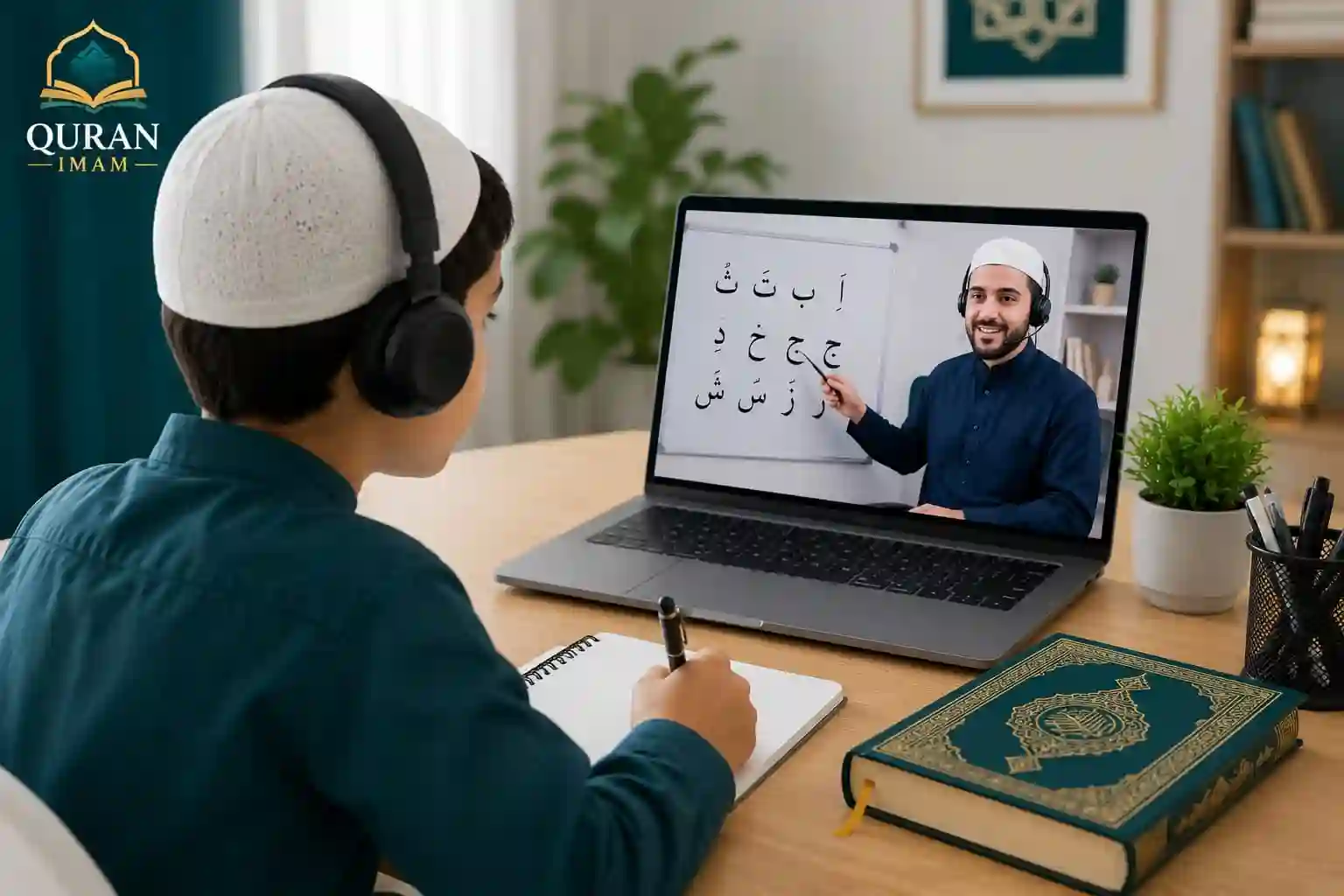
A well-structured Quranic Arabic course normally includes:
- Learning the Arabic alphabet.
- Correct pronunciation of Arabic letters.
- Frequently repeated Quranic vocabulary.
- Essential Quranic grammar.
- Quranic sentence structure.
- Reading with understanding.
- Practical application during Quran recitation.
- Continuous revision and progress tracking.
Rather than overwhelming beginners with advanced grammar, effective courses introduce each concept gradually, allowing confidence to grow naturally alongside understanding.
Why Learn Quranic Arabic Instead of General Arabic?
One of the most common questions learners ask is whether they should study Modern Standard Arabic before learning Quranic Arabic.
The answer depends entirely on their personal goal.
If your objective is travelling, business communication, or university study, Modern Standard Arabic may be the better choice.
However, if your primary goal is understanding the Quran, then learning Quranic Arabic first usually provides a much more direct and rewarding path.
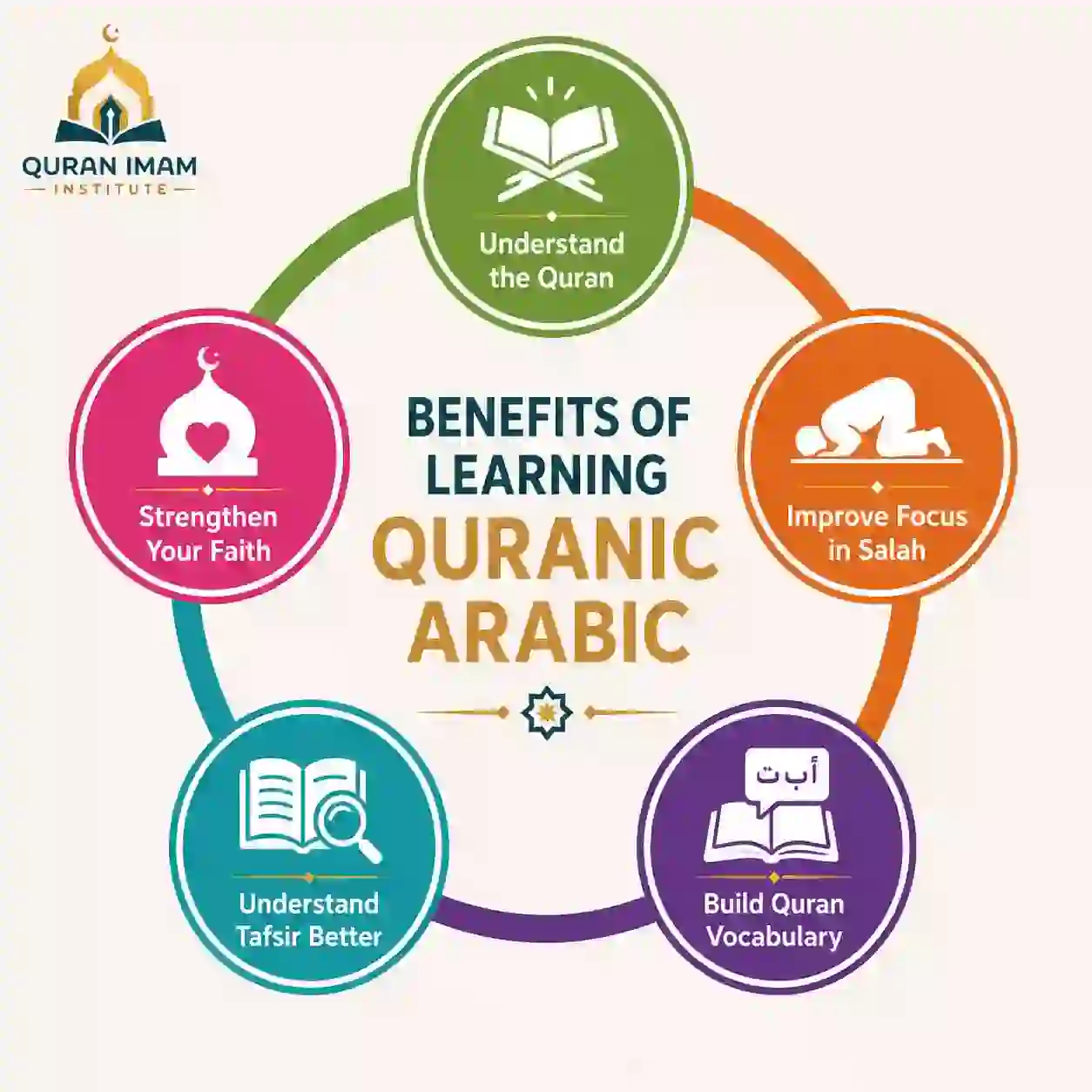
A Quranic Arabic course focuses specifically on the language Muslims encounter every day while reading the Quran, making Salah, studying Tafsir, and reflecting upon Allah’s words.
Students gradually learn to:
- Understand verses they recite regularly.
- Recognise frequently repeated Quranic vocabulary.
- Improve concentration during Salah.
- Follow Tafsir with greater confidence.
- Understand the relationship between words and meanings.
- Appreciate the linguistic beauty of the Quran.
One observation we repeatedly see in our lessons is that students become increasingly motivated once they realise how often the same Quranic words appear throughout different Surahs. Every new lesson strengthens their understanding of verses they already recite.
Who Can Benefit from a Quranic Arabic Course?
Many people mistakenly believe that Quranic Arabic is only suitable for scholars or advanced students.
In reality, it benefits almost every Muslim regardless of age or previous experience.
Quranic Arabic Course for Complete Beginners
Many learners begin with no Arabic knowledge whatsoever.
A structured learning pathway starts with the Arabic alphabet before introducing vocabulary, grammar, and Quranic understanding in manageable stages. This allows beginners to develop confidence without feeling overwhelmed.
Quranic Arabic Course for Adults
Adults often believe they have started too late.
Our teaching experience consistently shows the opposite.
One of our students, Ali, began learning at the age of forty-two without being able to read Arabic. Through regular one-to-one lessons, consistent attendance, and continuous revision, he gradually developed the confidence to read complete Quran pages fluently. His progress demonstrates that age is rarely the biggest obstacle. Commitment and consistency have a far greater impact.
Quranic Arabic Course for Children
Children often respond exceptionally well to gradual learning supported by repetition and encouragement.
Learning Quranic Arabic alongside Quran reading helps many young learners understand what they are reciting rather than simply memorising sounds. This deeper understanding often increases motivation and strengthens their connection with the Quran from an early age.
Quranic Arabic Course for Reverts
Many new Muslims wish to understand the Quran beyond English translations.
A structured Quranic Arabic course provides a practical foundation by helping reverts recognise common Quranic vocabulary, understand basic sentence structures, and gradually develop confidence in both reading and worship.
For students who prefer individual attention, working with a private Quran tutor can make learning more flexible and personalised. One-to-one lessons allow teachers to adapt the pace, explain difficult concepts clearly, and provide regular feedback.

Common Challenges When Learning Quranic Arabic
Every learner faces challenges during the early stages.
These difficulties are completely normal and should never discourage continued learning.
Some of the most common challenges include:
- Feeling that Arabic is too difficult.
- Forgetting newly learned vocabulary.
- Confusing similar Arabic letters.
- Understanding grammar.
- Fear of making mistakes.
- Limited time for revision.
- Missing lessons.
- Expecting rapid progress.
From our teaching experience, students who attend lessons consistently and revise between lessons usually overcome these challenges steadily. Small improvements made every week almost always produce stronger long-term results than studying intensively for a short period before stopping.
How Is a Quranic Arabic Course Taught?
A successful Quranic Arabic course should build understanding progressively rather than overwhelming students with technical grammar from the beginning.
At Quran Imam, every learner follows a personalised learning plan based on their current level, previous experience, and personal goals.
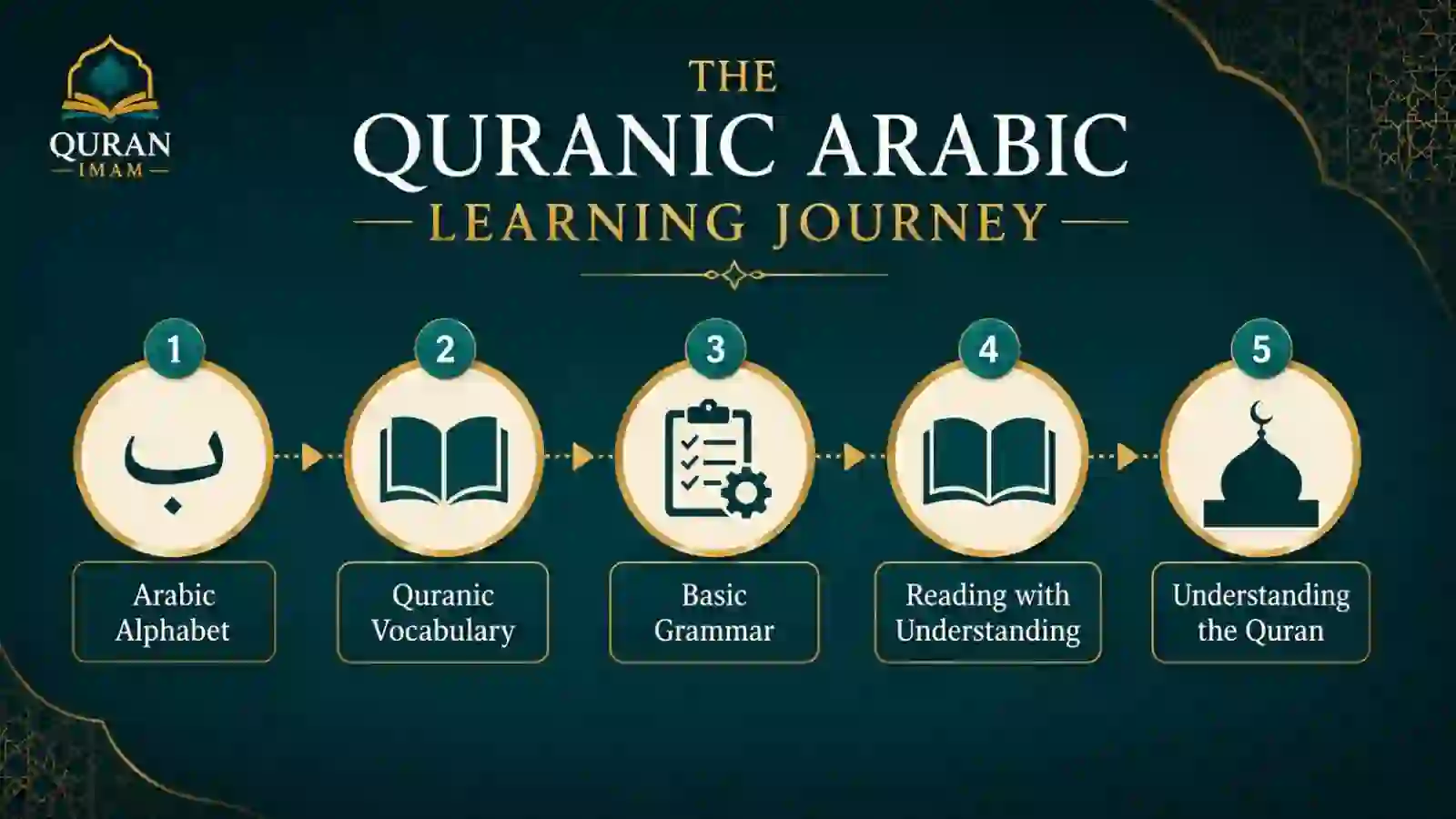
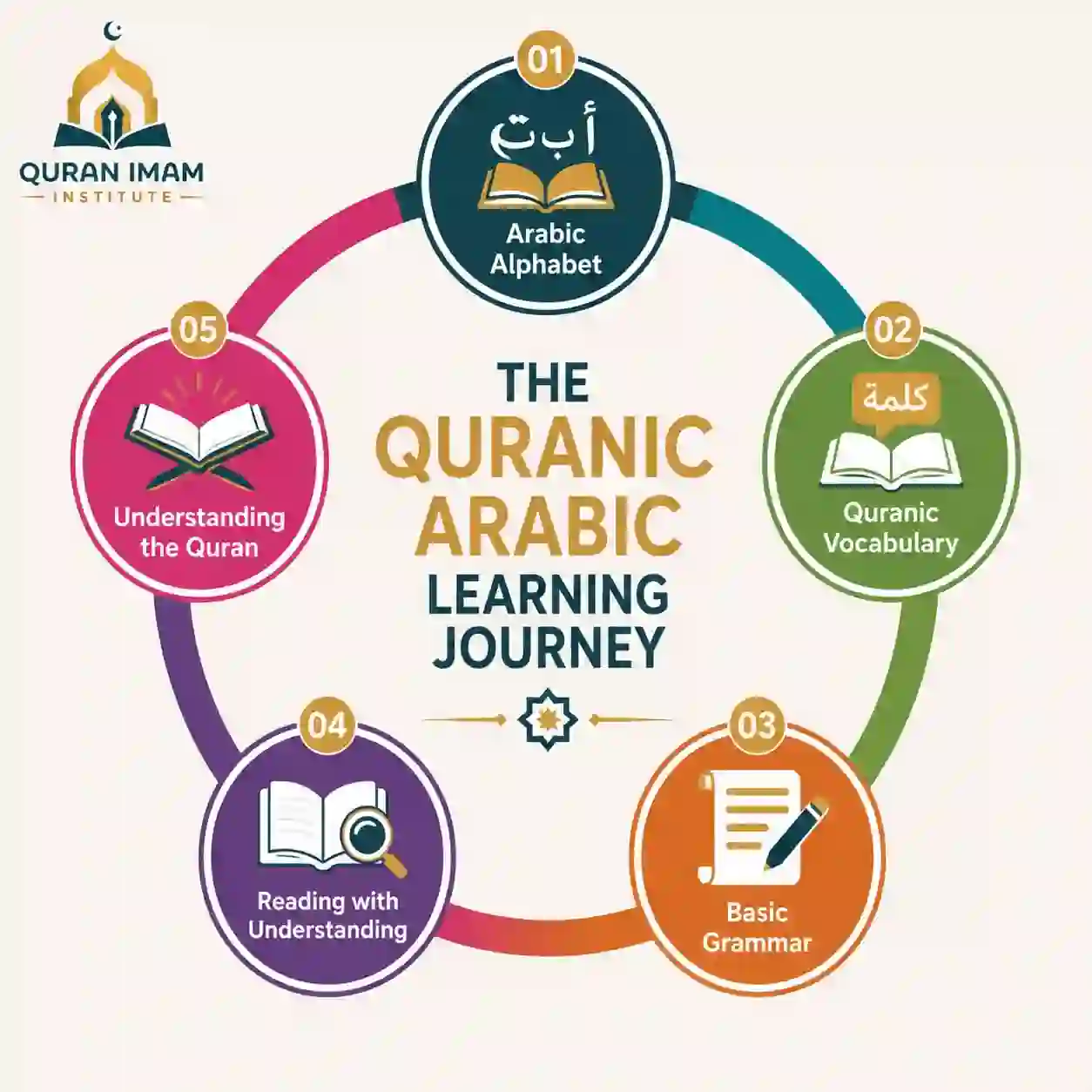
Our teaching approach develops through four connected stages.
Stage One: Learning the Arabic Alphabet
Students first learn to recognise every Arabic letter correctly while developing accurate pronunciation and confidence.
A strong foundation at this stage makes every future lesson significantly easier.
Stage Two: Building Quranic Vocabulary
Rather than memorising unrelated vocabulary lists, students learn words that appear frequently throughout the Quran.
Repeated exposure allows learners to recognise these words naturally during recitation, making each lesson immediately practical.
Stage Three: Understanding Quranic Grammar
Grammar is introduced gradually through real Quranic examples instead of abstract theory.
Students learn how meanings are constructed inside Quranic sentences without becoming overwhelmed by unnecessary terminology.
Stage Four: Reading with Understanding
As vocabulary and grammar develop together, students gradually recognise increasing amounts of the Quran directly from the Arabic text.
Instead of depending entirely on translations, they begin understanding verses naturally while reading, listening, and reflecting on the Quran.
What Makes a Quranic Arabic Course Effective?
Not every Quranic Arabic course delivers the same learning experience. While many programmes teach Arabic vocabulary and grammar, long-term success depends on how knowledge is presented, practised, and reinforced.
Based on our teaching experience, students make the strongest progress when several essential elements work together.
Personalised Learning
- Every learner starts from a different point.
- Some students already read the Quran fluently but struggle to understand its meanings.
- Others begin without recognising any Arabic letters.
- A personalised learning plan allows teachers to adapt each lesson to the student’s level, helping them progress steadily without unnecessary pressure.
Consistent Revision
- Revision is one of the most important parts of learning Quranic Arabic.
- Many learners focus only on new lessons, but vocabulary and grammar are easily forgotten without regular review.
- Students who revise consistently usually build stronger long-term understanding and greater confidence.
Learning Through the Quran
Rather than studying isolated vocabulary lists, effective Quranic Arabic courses teach words and grammar through authentic Quranic verses.
Because many Quranic words appear repeatedly throughout different Surahs, students naturally strengthen their understanding every time they recite or revise.
Immediate Feedback
Correcting mistakes early prevents incorrect habits from becoming permanent.
Whether improving pronunciation, explaining grammar, or strengthening comprehension, continuous feedback helps students progress with confidence.

Real Teaching Experience at Quran Imam
At Quran Imam, every lesson contributes to our understanding of how students learn most effectively.
Over the years, we have taught children, adults, reverts, and complete beginners from different educational backgrounds.
Although every learner follows a unique journey, certain learning patterns appear repeatedly.
Students who attend lessons consistently, revise regularly, and receive personalised guidance almost always make stronger long-term progress than those who study intensively for short periods before stopping.
One example is Haroon, who joined Quran Imam while reading the Quran slowly and experiencing clear pronunciation errors. He also struggled to distinguish different types of Madd and frequently broke words incorrectly during recitation.
After approximately six months of consistent learning, his recitation improved significantly. His Makharij became much more accurate, he applied optional Madd rules correctly, including Madd ‘Arid Lil-Sukun, and developed confidence in observing the correct rules of Waqf and Ibtida’. He is now close to completing his full Quran recitation.
His journey highlights an important lesson that we observe repeatedly.
Consistent correction and gradual improvement often produce stronger results than rushing through lessons.
Teacher’s Observation
- One teaching pattern has become clear through years of working with beginners.
- Students rarely struggle because they cannot learn Quranic Arabic.
- They usually struggle because they try to learn too much too quickly without giving themselves enough time to revise.
- When learning is broken into small, achievable steps, students generally become more confident, retain vocabulary more effectively, and remain motivated for longer.
How Long Does It Take to Learn Quranic Arabic?
- This is one of the questions we receive most often from parents, adults, and new Muslims.
- The honest answer Is that there is no single timeline that applies to everyone.
- Progress depends on several important factors, including:
- Previous Arabic knowledge.
- Lesson frequency.
- Attendance consistency.
- Home revision.
- Individual learning ability.
- Personal motivation.
Based on our teaching experience, many committed beginners begin recognising Arabic letters, understanding frequently repeated Quranic vocabulary, and reading simple Quranic phrases within the first few months of regular study.
As lessons continue, students gradually recognise more vocabulary, understand sentence structures more naturally, and rely less on English translations.
Rather than asking how quickly they can finish, successful learners usually focus on learning consistently and building knowledge that remains with them for life.
If you are still comparing different learning options, it is worth exploring what makes a high-quality online Quran course before choosing a programme that matches your goals and experience.
Can You Learn Quranic Arabic Without Knowing Arabic?
Yes. Many of our students begin without any previous Arabic knowledge.
A structured Quranic Arabic course starts with the essentials before introducing more advanced concepts gradually.
Students are not expected to understand complicated grammar from the beginning.
Instead, they first learn:
- Arabic letters.
- Correct pronunciation.
- Frequently repeated Quranic words.
- Basic sentence patterns.
- Practical understanding through repeated Quran recitation.
- This gradual approach helps beginners build confidence while reducing frustration.
Does Learning Quranic Arabic Help with Quran Memorisation?
For many students, yes.
Although Quranic Arabic and Hifz are different learning goals, understanding the meanings of verses often makes memorisation more meaningful.
When students recognise vocabulary and understand how verses connect together, they frequently find it easier to remember what they have memorised.
From our teaching experience, students who combine regular revision with understanding usually develop stronger long-term retention than those who memorise without understanding.
Students who plan to memorise the Quran often benefit from following a structured Quran memorisation programme alongside their Arabic studies, as understanding vocabulary can support long-term retention.
Common Mistakes That Slow Progress
- Most students experience periods where progress feels slower than expected.
- In many cases, the reason is not ability but learning habits.
Expecting Immediate Results
- Understanding the Quran is a lifelong journey.
- Students who expect rapid fluency often become discouraged unnecessarily.
Skipping Revision
- Revision is not optional.
- Vocabulary and grammar become permanent only through repeated review.
Memorising Grammar Without Reading
- Grammar makes much more sense when learners repeatedly encounter it while reading the Quran.
- Reading, listening, revision, and grammar should always work together.
Inconsistent Attendance
Missing lessons regularly interrupts learning and reduces confidence.
- Even one lesson each week can produce excellent long-term progress when attendance remains consistent.
Comparing Yourself with Other Students
- Every learner develops differently.
- Some improve reading first.
- Others remember vocabulary more quickly.
- Comparing progress with others often reduces motivation instead of increasing it.
Quranic Arabic vs Modern Standard Arabic
- Many beginners are unsure which type of Arabic they should study first.
- The answer depends on their personal goal.
Quranic Arabic Modern Standard Arabic
Focuses on understanding the Quran Focuses on modern communication
Uses Quranic vocabulary Uses contemporary vocabulary
Helps with Quran recitation and Tafsir Helps with media, education, and business
Ideal for Muslims who want to understand the Quran Ideal for everyday communication and formal Arabic
If your primary goal is understanding the Quran, a dedicated Quranic Arabic course usually provides the most direct and rewarding learning pathway.
Most Common Benefits Students Notice
- As students continue learning consistently, many begin noticing practical improvements in their daily worship.
- These often include:
- Greater understanding during Quran recitation.
- Better concentration in Salah.
- Increased recognition of repeated Quranic vocabulary.
- Improved confidence when reading the Quran.
- Greater motivation to continue Islamic learning.
- A stronger personal connection with the Quran.
- Every student’s progress is different, but these are some of the most common positive changes we observe over time.
How to Choose the Best Quranic Arabic Course
Choosing the right Quranic Arabic course can have a significant impact on both your learning experience and your long-term progress. While many courses appear similar at first glance, the quality of teaching, lesson structure, and student support can vary considerably.
Before enrolling, it is worth asking a few important questions.
Are the Teachers Qualified?
- A good course should be taught by qualified teachers who have experience helping non-Arabic speakers understand the Quran.
- Knowledge alone is not enough.
- Teachers should also know how to explain concepts clearly, correct mistakes patiently, and adapt lessons to different learning styles.
Is the Course Designed for Your Level?
- Complete beginners need a different approach from students who already read the Quran.
- Look for a course that starts from your current level rather than expecting every learner to follow the same programme.
Are Lessons Personalised?
- Personalised one-to-one lessons allow teachers to focus on each student’s strengths, challenges, and goals.
- This often leads to faster understanding, greater confidence, and more consistent progress.
Is There a Clear Learning Plan?
- Students should understand what they are learning and why.
- A structured curriculum helps learners move gradually from recognising Arabic letters to understanding Quranic vocabulary and sentence structures.
Is Progress Monitored?
Regular feedback and progress reviews help students stay motivated while identifying areas that require additional revision.
Many families also compare different academies before enrolling. Reading independent online Quran classes reviews can help you understand what to look for in terms of teaching quality, communication, and student support.
Why Choose Quran Imam?
At Quran Imam, we believe learning should be measured by meaningful progress rather than how quickly students complete a syllabus.
Every learner receives a personalised learning plan designed around their current level, goals, and pace of learning.
Our teaching approach is built upon years of experience working with children, adults, reverts, and complete beginners from different backgrounds.
Students benefit from:
- Qualified Al-Azhar teachers.
- Personalised one-to-one online lessons.
- Flexible scheduling for UK families.
- Structured learning pathways.
- Regular progress assessments.
- Continuous teacher feedback.
- A supportive learning environment.
- Lessons tailored to beginners and advanced learners alike.
- Rather than making unrealistic promises, we focus on helping students build lasting confidence, understanding, and consistency.
Still unsure if this course is the right choice for you or your child? A free trial lesson gives you the opportunity to meet one of our qualified teachers, experience a personalised one-to-one class, and discuss your learning goals before making any commitment. You’ll also see how our structured teaching approach helps students build confidence and understand the Quran step by step from the very first lesson.
Frequently Asked Questions
Is this Quranic Arabic course suitable for complete beginners?
Yes. Many of our students begin with no previous Arabic knowledge. Lessons start from the Arabic alphabet before gradually introducing Quranic vocabulary, grammar, and sentence structures.
Can adults successfully learn Quranic Arabic?
Yes. Based on our teaching experience, many adult learners have made excellent progress through regular lessons and consistent revision. Age is rarely the deciding factor. Commitment and consistency are much more important.
Is Quranic Arabic different from Modern Standard Arabic?
Yes. Modern Standard Arabic focuses on communication in modern contexts, while Quranic Arabic focuses specifically on understanding the language of the Quran.
Will this course help me understand the Quran?
The purpose of a Quranic Arabic course is to help students gradually recognise Quranic vocabulary, understand common sentence structures, and appreciate the meanings of verses directly from the Arabic language.
Does understanding Quranic Arabic improve Salah?
Many students find that recognising the meanings of verses helps them concentrate more during prayer and reflect more deeply on what they are reciting.
How many lessons should I take each week?
There is no single schedule that suits everyone. However, regular attendance combined with consistent home revision usually leads to stronger long-term progress than studying intensively for short periods.
Do I need to know Arabic before joining?
No. Complete beginners are welcome. Lessons can begin from learning the Arabic alphabet.
Will I become fluent in Arabic?
A Quranic Arabic course Is designed to help students understand the language of the Quran rather than achieve complete fluency in spoken Arabic. Progress varies according to lesson frequency, revision, attendance, and individual commitment.
Can children study Quranic Arabic alongside Quran reading?
Yes. Many children benefit from learning Quranic Arabic while improving their Quran recitation. Understanding simple vocabulary often increases motivation and strengthens their relationship with the Quran.

Is there a free trial lesson?
Yes. A free trial lesson allows you to meet one of our qualified teachers, discuss your learning goals, and experience our personalised teaching approach before deciding to enrol.