


Finding the right Quran teacher in UK is about far more than choosing someone who can teach Quran recitation. For most families, the decision is based on trust. Parents want to know that their child will enjoy learning, stay motivated, and receive patient guidance from a qualified teacher who understands that every student learns differently.
Adult learners often have different concerns. Many worry that they have started too late, that their Arabic is too weak, or that they will struggle to balance Quran lessons with work and family life. These are conversations we have with families across the UK every week.
Some parents tell us their child previously attended Quran classes but gradually lost interest. Others explain that travelling to lessons after school has become difficult because of busy schedules.
Adult students often say they have wanted to learn the Quran properly for years but never found a programme that suited their routine.
Choosing the right teacher is not simply about qualifications. It is about finding someone who understands these concerns, recognises the challenges behind them, and knows how to help students overcome them with patience and consistency.
At Quran Imam, we have taught children, teenagers, adults, and new Muslims from a wide range of backgrounds. Some students join us without recognising a single Arabic letter, while others want to strengthen their Tajweed or continue their Hifz journey.
Although every learner progresses differently, one lesson has remained constant throughout our teaching experience: meaningful progress comes from personalised teaching, consistent attendance, and regular revision rather than rushing through lessons.
That is why every lesson at Quran Imam is delivered on a one-to-one basis by qualified Al-Azhar teachers. Instead of expecting students to adapt to a fixed teaching style, we adapt our teaching to the individual learner. This personalised approach has helped many families across the UK make Quran learning both practical and enjoyable.
Whether you live in London, Birmingham, Manchester, Glasgow, Leeds, or anywhere else in the UK, learning with an experienced Quran teacher in UK has never been more accessible.
Quick Answer
If you are looking for a Quran teacher in UK, choose a qualified teacher who offers personalised one-to-one online lessons rather than a one-size-fits-all programme. Based on our teaching experience, students often make steadier progress when lessons are tailored to their individual needs, supported by regular revision, and delivered consistently by the same teacher over time.
Table of Contents
- Why Choosing the Right Quran Teacher Matters
- What Parents Often Ask Before Enrolling
- What Makes a Great Quran Teacher?
- Why Many UK Families Prefer One-to-One Lessons
- Who Can Benefit from an Online Quran Teacher?
- What Can You Learn?
- From Our Teaching Experience
- What Progress Can You Expect?
- Common Challenges We Regularly See
- How Online Quran Lessons Work
- How to Choose the Right Quran Teacher in UK
- Why Families Choose Quran Imam
- Frequently Asked Questions
- Final Thoughts
Why Choosing the Right Quran Teacher Matters
Many people assume that learning the Quran is simply a matter of attending lessons each week. In reality, the teacher often has the greatest influence on whether a student enjoys learning, builds confidence, and continues making progress over the long term. Over the years, we have noticed that students rarely stop learning because the Quran itself is too difficult. More often, progress slows because the teaching approach does not suit the learner. Some children lose confidence when they are expected to keep pace with larger groups. Adults sometimes hesitate to ask basic questions because they worry about making mistakes.
A good Quran teacher recognises these differences and adjusts the learning experience accordingly.
For one student, repeated listening may be the key to improving pronunciation. Another student may understand quickly but need more practice to read fluently. Some children gain confidence long before they become fluent readers, while others read comfortably before showing an interest in memorisation.
Teaching every student in exactly the same way rarely produces the best results.
One of the most valuable lessons we have learned is that confidence often develops before fluency. Once students feel comfortable asking questions, reading aloud, and learning from their mistakes, they usually become more willing to practise consistently. Over time, that consistency becomes the foundation for lasting progress.
What Parents Often Ask Before Enrolling
Before booking their first lesson, many parents ask us very similar questions.
- Will my child stay focused during an online lesson?
- What if they have tried Quran classes before without success?
- How long will it take before they begin reading confidently?
These are all reasonable questions, and we encourage families to discuss them openly during the free trial lesson.
Rather than giving every family the same answer, we begin by understanding the student’s current level, previous learning experience, and personal goals. This allows us to recommend a learning plan that matches the student instead of expecting the student to fit into a fixed programme.
Parents are often relieved to discover that their child does not need to be “naturally gifted” to succeed. In our experience, consistent attendance, supportive parents, regular revision, and a patient teacher usually have a much greater influence on long-term progress than natural ability alone.
What Makes a Great Quran Teacher?
Parents often ask us:
“How do I know whether a Quran teacher is the right fit for my child?”
It is an important question because qualifications alone do not always determine whether a teacher will help a student succeed.
A great Quran teacher combines knowledge with patience, experience, adaptability, and the ability to build trust.
Strong Islamic Knowledge
Every student deserves to learn from a teacher with a sound understanding of the Quran, Tajweed, and correct Islamic etiquette. Accurate recitation should always be the foundation of every lesson.
Experience Teaching Different Learners
Teaching a young child is very different from teaching an adult who has returned to learning after many years.
Through our experience, we have found that students progress more comfortably when teachers adapt their teaching style instead of expecting every learner to follow the same method.
Some students benefit from repetition. Others learn more effectively through explanation and discussion. Recognising these differences allows lessons to remain productive without becoming overwhelming.
Patience During Mistakes
Many beginners worry about making mistakes while reading the Quran.
We see mistakes differently.
Every confident reader once struggled with unfamiliar Arabic letters, difficult sounds, or remembering Tajweed rules. A patient teacher corrects mistakes with encouragement, helping students develop confidence instead of fear.
Clear Communication
Many students in the UK speak English as their first language and have little previous experience with Arabic.
Explaining pronunciation, Tajweed, and lesson objectives clearly in English helps students understand not only what they are learning but also why each step matters. This often leads to stronger understanding and better long-term retention.
Consistency Matters More Than Speed
One observation has remained remarkably consistent throughout our teaching experience.
Students who attend lessons regularly, revise between sessions, and continue learning with the same teacher often make steadier progress than students who study intensively for a short period before stopping.
Learning the Quran is not a race. It is a lifelong journey built through patience, guidance, and consistency.
Why Many UK Families Prefer One-to-One Lessons
One of the biggest changes we have seen in recent years is the growing number of families choosing personalised online lessons instead of traditional group classes.
Convenience is certainly one reason, but it is rarely the only one.
Parents often tell us they want their child to receive individual attention rather than waiting for a teacher to divide time between several students.
We have also seen how one-to-one lessons allow teachers to identify pronunciation mistakes much earlier. Sounds such as ع, ح, خ, غ, and ق often require repeated guidance during the early stages of learning. When corrections are made immediately, students usually develop stronger reading habits from the beginning.
Another important advantage is flexibility.
Every family follows a different routine. School, homework, work commitments, and family responsibilities all affect when lessons can take place. Flexible scheduling makes it easier for students to attend consistently, and consistency is one of the strongest predictors of long-term progress.
Perhaps the greatest benefit, however, is confidence.
Students who feel comfortable making mistakes, asking questions, and reading aloud without embarrassment usually become more engaged in the learning process. Over time, this confidence supports both better recitation and a more positive relationship with the Quran.

Who Can Benefit from an Online Quran Teacher?
One of the questions we hear most often is whether online Quran lessons are suitable for everyone or only for children.
Our experience has shown that there is no single type of Quran student. Every learner arrives with different goals, different challenges, and a different starting point. That is why personalised teaching is so valuable.
Children Beginning Their Quran Journey
Many children start with little or no knowledge of the Arabic alphabet. At this stage, the priority is not simply learning letters but building confidence.
We have found that children respond best when lessons are interactive, encouraging, and structured around achievable goals. Rather than rushing through new material, we focus on helping students feel comfortable with what they have already learned before introducing the next step.
Teenagers Balancing School and Quran
Teenagers often have demanding schedules filled with school, homework, examinations, and extracurricular activities.
Flexible online lessons allow families to fit Quran learning around these commitments without the added time required for travelling to classes. More importantly, students are able to maintain consistency throughout the school year, which often has a greater impact on progress than increasing the number of lessons.
Adults Returning to Learning
Many adults begin their first lesson with the same concern:
“I wish I had started years ago.”
Fortunately, learning the Quran is not limited by age.
Some of our adult students joined us without recognising Arabic letters. Through regular lessons, patient guidance, and consistent home revision, they gradually developed the confidence to read directly from the Mushaf. Their progress was not the result of extraordinary ability but of steady commitment over time.
New Muslims
For new Muslims, learning the Quran often goes hand in hand with learning the basics of Islam.
This can feel overwhelming at first, which is why patience is so important.
Our teachers introduce new concepts gradually, encourage questions, and allow students to progress at a pace that feels comfortable. Building confidence during these early stages often makes the learning journey far more enjoyable.
What Can You Learn?
Every student joins Quran Imam with different objectives.
Some want to learn how to read the Quran correctly for the first time. Others want to improve their Tajweed, memorise additional Surahs, or deepen their understanding of Quranic Arabic.
Your learning plan is built around your current level and long-term goals.
Learning the Arabic Alphabet
For complete beginners, lessons begin with recognising Arabic letters, understanding how they connect, and learning the correct pronunciation of each sound.
Strong foundations make future reading significantly easier.
Reading the Quran with Confidence
Students gradually move from recognising letters to reading words, verses, and complete Quran pages with increasing fluency.
Rather than measuring progress by speed alone, we focus on developing accurate and confident reading habits that remain with the student long after the lesson has ended.
Improving Tajweed
Tajweed is introduced gradually through practical application.
Instead of overwhelming students with theoretical rules, teachers explain and correct pronunciation while students are reading. In our experience, this approach helps learners understand and remember Tajweed more naturally.
Quran Memorisation (Hifz)
Students following a Hifz programme receive a balanced schedule that combines new memorisation with continuous revision.
One pattern we have seen repeatedly is that students who focus only on memorising new Surahs often struggle to retain what they have already learned. Regular Muraja’ah is not an optional extra—it is an essential part of successful memorisation.
Building Confidence
Many students begin their journey believing that they are “not good at Arabic.”
Over time, they discover that confidence grows through consistent practice, patient correction, and supportive teaching.
In many cases, we have seen confidence improve before fluency. Once students stop worrying about making mistakes, they usually become more willing to practise, ask questions, and continue learning.
From Our Teaching Experience
Every student teaches us something.
After working with learners from different ages and backgrounds, we have noticed certain patterns that appear again and again.
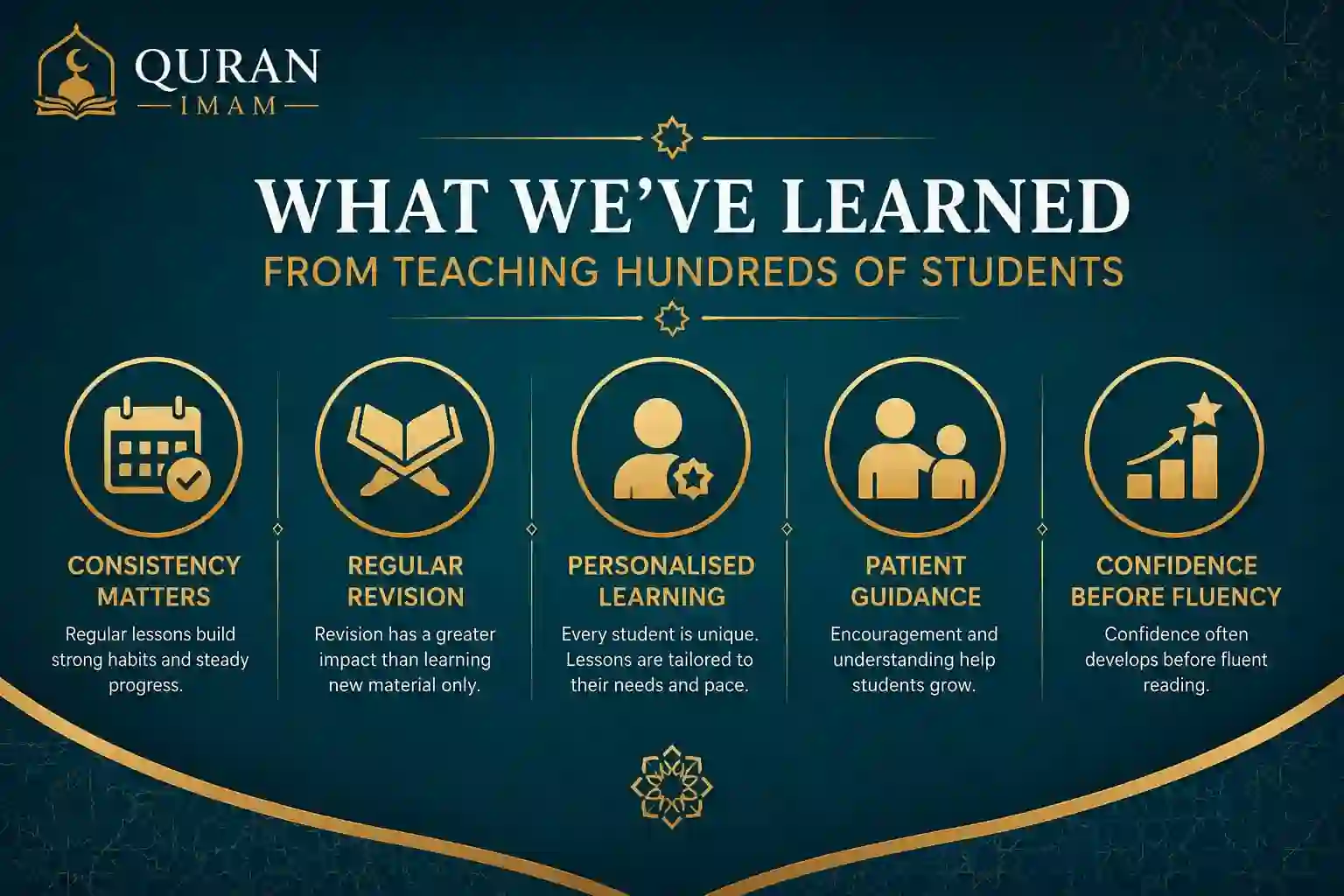
- Students who attend lessons consistently almost always make steadier progress than those who study intensively for a short period before stopping.
- Children often become confident readers only after they stop worrying about making mistakes.
- Adults frequently underestimate their ability to learn because they compare themselves with younger students.
- Regular revision has a greater impact on long-term progress than increasing the number of weekly lessons.
- Students usually remain more motivated when they learn with the same teacher over an extended period.
- Small pronunciation mistakes are much easier to correct during the early stages than after they become long-term habits.
These observations do not guarantee identical results for every student, but they have consistently shaped the way we teach at Quran Imam.
What Progress Can You Expect?
Perhaps the most common question parents ask is:
“How long will it take before my child can read the Quran?”
The honest answer is that no responsible teacher can promise an exact timeline.
Progress depends on several factors, including lesson frequency, home revision, attendance, age, and the student’s individual learning pace.
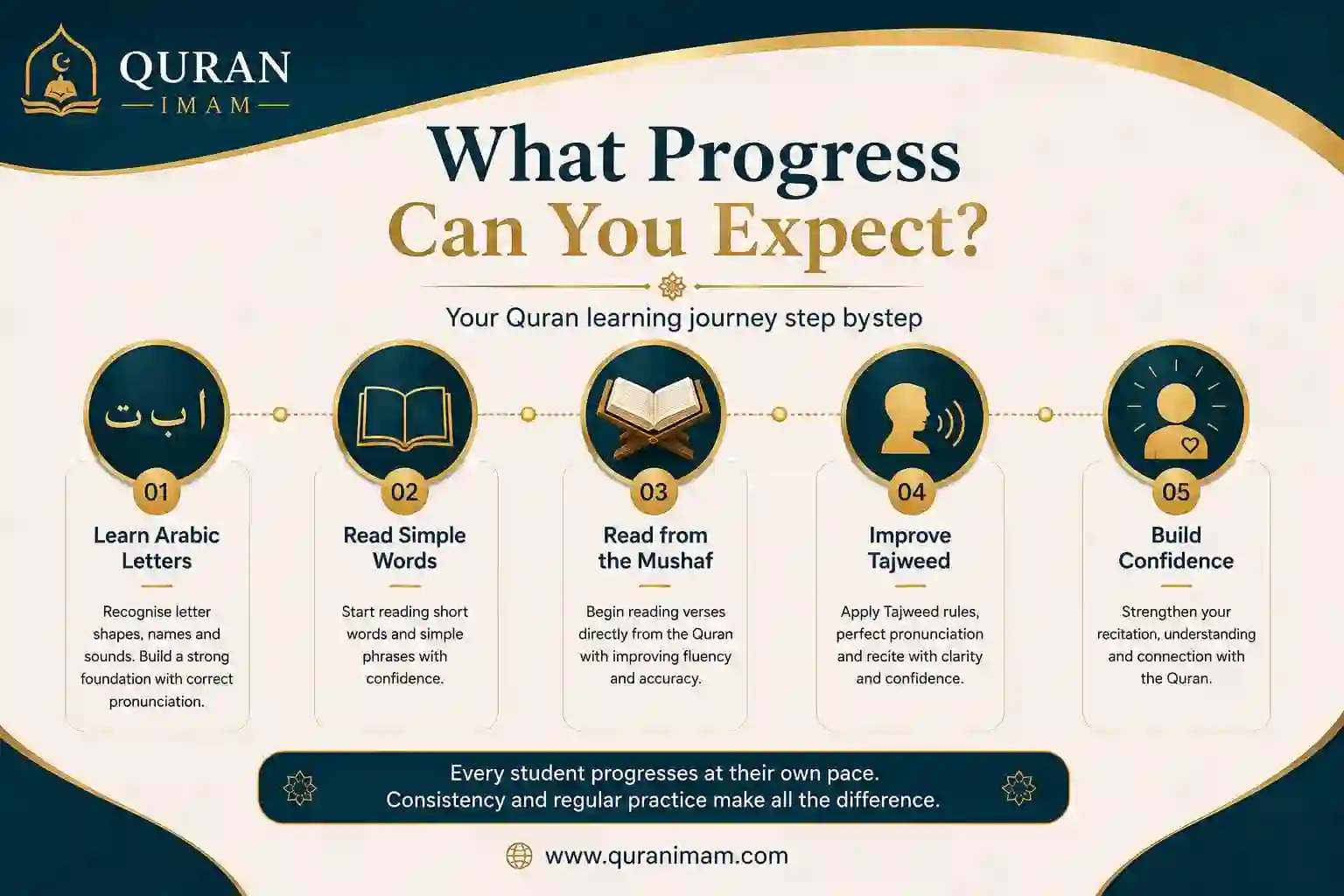
However, our teaching experience has shown that students who attend around three lessons each week, revise regularly at home, and continue learning with the same teacher often begin to:
- Recognise the Arabic alphabet confidently.
- Read simple Arabic words independently.
- Start reading directly from the Mushaf.
- Improve pronunciation and Makharij.
- Apply basic Tajweed rules while reading
It is important not to compare one student’s journey with another.
Some children become confident readers quickly but require more time for memorisation. Others memorise Surahs with ease while continuing to refine their pronunciation.
This variation is completely normal.
Rather than following a rigid timetable, we adapt each learning plan to the student’s pace so that progress remains steady and sustainable.
Common Challenges We Regularly See
Learning the Quran is a rewarding journey, but it is also normal to face challenges along the way.
Over the years, we have seen many students overcome the same obstacles through patience, consistency, and supportive teaching.
Pronouncing Arabic Letters
Letters such as ع, ح, خ, غ, and ق are unfamiliar to many English speakers.
Developing accurate pronunciation takes time, repeated practice, and immediate feedback from an experienced teacher. Learn Arabic language
Fear of Making Mistakes
Many beginners apologise every time they make an error.
We remind students that mistakes are not signs of failure—they are evidence that learning is taking place.
Creating a supportive environment allows students to become more confident readers over time.
Irregular Revision
Revision is often the first thing students stop doing when life becomes busy.
Unfortunately, it is also one of the biggest reasons progress slows.
Even short periods of regular revision usually produce better long-term results than long study sessions followed by several days without practice
Inconsistent Attendance.
Consistency matters.
Students who attend lessons regularly generally build stronger habits, retain more information, and develop greater confidence than those whose learning is interrupted frequently.
How Online Quran Lessons Work
Getting started is simple.
The first step is a free trial lesson, where the teacher takes time to understand the student’s current level, previous experience, and learning goals.
Following this assessment, a personalised learning plan is created.
Lessons are then scheduled at times that suit the family, allowing students to learn from home while receiving live one-to-one guidance from the same qualified teacher.
Throughout the learning journey, teachers continue to monitor progress, adjust lesson plans where needed, and encourage regular revision between classes.

Why Families Across the UK Choose Quran Imam
Families choose Quran Imam for many different reasons, but one thing they often tell us is that they appreciate being treated as individuals rather than simply another student joining a programme.
Our teaching philosophy is built on a few simple principles:
- Personalised one-to-one learning.
- Qualified Al-Azhar teachers.
- Flexible scheduling for families across the UK.
- Regular progress monitoring.
- Continuous revision alongside new learning.
- Honest expectations based on experience rather than unrealistic promises.
- A supportive learning environment where students feel comfortable asking questions and learning from their mistakes.
Our goal is not simply to help students complete lessons.
It is to help them build confidence, develop consistency, and establish a lifelong relationship with the Quran.

Frequently Asked Questions
How do I choose the best Quran teacher in UK?
Choose a teacher with strong Islamic knowledge, recognised qualifications, teaching experience, and a personalised approach. A free trial lesson is one of the best ways to decide whether the teacher is the right fit.
Can children really learn the Quran online?
Yes. Many children learn very successfully online when lessons are interactive, personalised, and supported by regular practice at home.
Is it too late for adults to start learning?
No. We have taught many adults who began as complete beginners. With consistent lessons and home revision, many gradually became confident Quran readers.
How many lessons each week do you recommend?
Two or three lessons each week, combined with regular revision, provide a strong foundation for many students. The best schedule is one that families can maintain consistently.
Do you provide female Quran teachers?
Yes. We understand that many families prefer female teachers for women and children. Qualified female Quran teachers are available upon request.
What if my child has tried Quran classes before?
Previous experience does not determine future success. Sometimes students simply need a teaching approach that better matches their learning style and pace.
Do I need any previous Arabic knowledge?
No. Complete beginners are welcome, and lessons begin from the student’s current level.
Do you offer a free trial lesson?
Yes. The free trial lesson allows you to meet your teacher, discuss your goals, and experience personalised one-to-one learning before enrolling.
Final Thoughts
Finding the right Quran teacher in UK is about more than choosing a convenient timetable or an online platform. It is about finding a teacher who understands how students learn, adapts to their individual needs, and provides the encouragement needed to keep them progressing with confidence.
At Quran Imam, our teaching approach has been shaped by years of working with children, adults, and new Muslims from different backgrounds. That experience has taught us that meaningful progress rarely comes from rushing through lessons. It comes from personalised teaching, consistent attendance, regular revision, and a supportive relationship between the teacher, the student, and the family.
Whether you are looking for a Quran teacher for your child or beginning your own Quran journey, we would be honoured to support you.