


Quick Answer
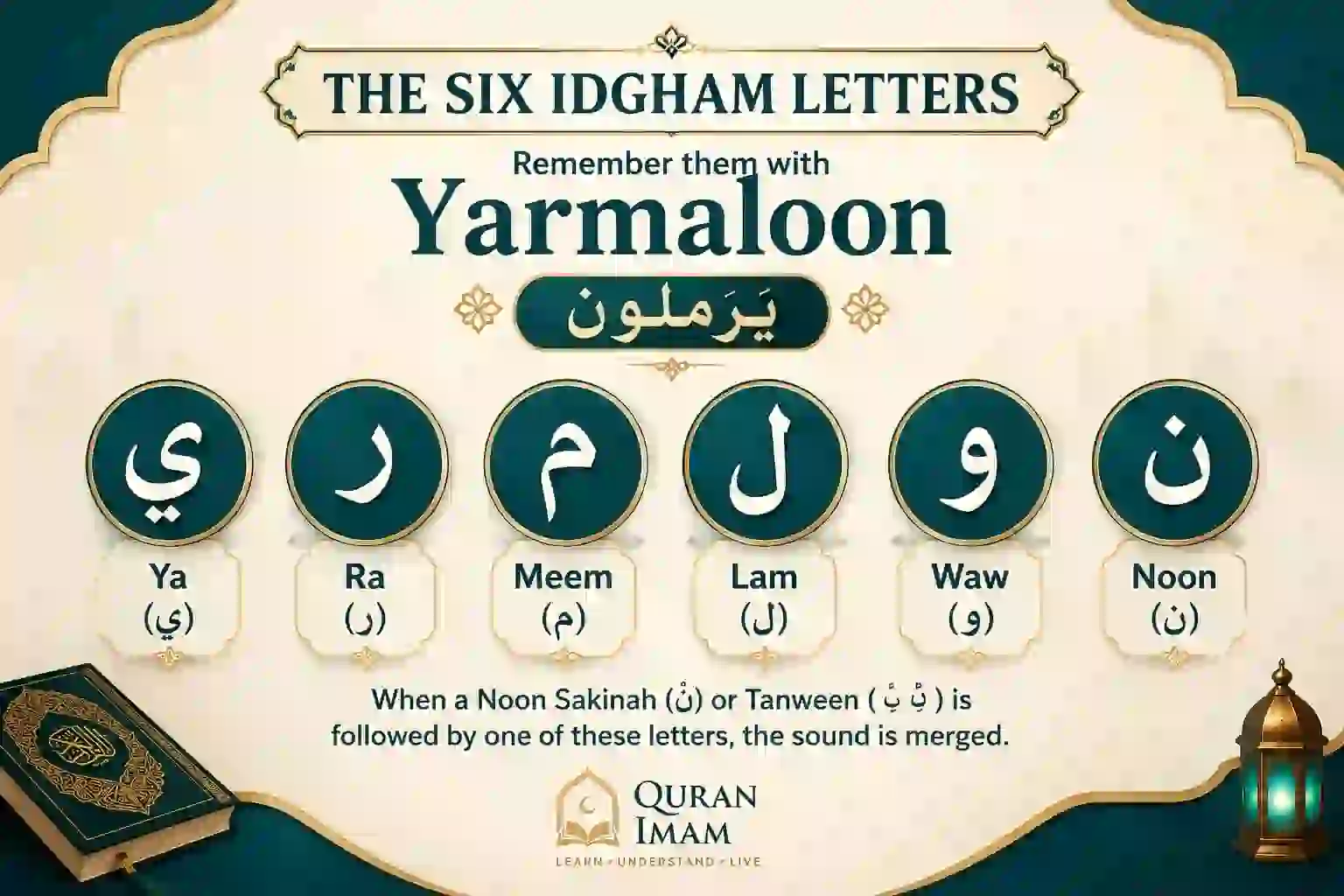
The Idgham letters are six Arabic letters used in one of the most important Tajweed rules for Noon Sakinah (نْ) and Tanween (ــًــٍــٌ). These letters are Ya (ي), Ra (ر), Meem (م), Lam (ل), Waw (و), and Noon (ن), commonly remembered using the word Yarmaloon (يرملون).
Whenever a Noon Sakinah or Tanween is immediately followed by one of these six letters, the sound is merged into the following letter according to the rules of Tajweed. Four of these letters are pronounced with Ghunnah (nasalisation), while the remaining two are pronounced without it.
Learning the Idgham rule helps beginners recite the Quran more smoothly, recognise common Tajweed patterns, and improve their pronunciation with confidence.
Table of Contents
- What Are Idgham Letters?
- Why Are Idgham Letters Important?
- The Six Idgham Letters
- What Does Yarmaloon Mean?
- When Is Idgham Applied?
- How Is Idgham Different from Other Noon Sakinah Rules?
- Idgham with Ghunnah
- Idgham without Ghunnah
- Quran Examples of Idgham
- Common Mistakes Beginners Make
- Why Beginners Confuse Idgham with Ikhfa
- How to Practise Idgham at Home
- Frequently Asked Questions
What Are Idgham Letters?
One of the first Tajweed rules every beginner learns is Idgham.
The Arabic word Idgham (إدغام) literally means to merge or to blend one sound into another. In Quran recitation, this rule applies when a Noon Sakinah (نْ) or Tanween (ــًــٍــٌ) is immediately followed by one of six specific Arabic letters.
Instead of pronouncing the Noon or Tanween separately, the sound flows naturally into the following letter. This creates a smoother and more accurate recitation while preserving the authentic pronunciation that has been transmitted from the Prophet Muhammad ﷺ through generations of qualified Quran teachers.
Although the rule sounds technical at first, it quickly becomes natural with regular practice. Most students begin recognising Idgham while reading long before they can explain the rule using Tajweed terminology.
If you are completely new to Quran recitation, we recommend reading our guide How to Read Quran for Beginners (Easy Step-by-Step Guide) before studying individual Tajweed rules.
Why Are Idgham Letters Important?
Many beginners believe Tajweed is simply about memorising complicated rules.
In reality, Tajweed is about preserving the correct pronunciation of the Quran while making recitation clear, accurate, and beautiful.
Learning the Idgham letters helps you:
- Read the Quran more fluently.
- Reduce hesitation while reciting.
- Recognise common pronunciation patterns.
- Improve listening and reading skills.
- Build confidence during Quran recitation.
- Prepare for learning more advanced Tajweed rules.
Based on our experience teaching students at Quran Imam, one of the biggest changes we notice is that beginners initially stop at almost every Noon Sakinah because they are unsure which rule applies. After consistent guided practice, they begin recognising the Idgham pattern automatically and their recitation becomes noticeably smoother.
Rather than memorising long lists of Tajweed terminology, students make the greatest progress by combining regular reading with personalised correction and revision.
As explained in our article Quran Tajweed Rules: A Beginner’s Guide to Correct Quran Recitation, learning Tajweed is a gradual journey that develops through consistency rather than speed.
The Six Idgham Letters
There are only six Idgham letters, making them relatively easy to memorise.
They are:
- ي (Ya)
- ر (Ra)
- م (Meem)
- ل (Lam)
- و (Waw)
- ن (Noon)
Students usually remember these six letters using one simple mnemonic:
Yarmaloon (يرملون)
Although Yarmaloon is not a word from the Quran, it has been used by Tajweed teachers for generations because it places all six letters into one memorable word.
This method is particularly useful for children and for adults learning Arabic as a second language.
Instead of trying to memorise six individual letters, students simply remember one word and then learn how each letter functions within the rule.
What Does Yarmaloon Mean?
One of the questions beginners ask most often is:
“Does the word Yarmaloon have a meaning?”
- The answer is no.
Yarmaloon is simply a mnemonic used to help students remember the six Idgham letters. It was created as a teaching aid rather than as a vocabulary word.
At Quran Imam, we encourage students to understand the rule before relying on memory tricks. Once learners understand why Idgham happens, remembering the letters becomes much easier.
Many children can memorise the word “Yarmaloon” within minutes, but they still hesitate during recitation because they are unsure when the rule should actually be applied.
For this reason, our teachers always combine memorisation with practical Quran reading. Students are encouraged to recognise Idgham while reading real verses instead of treating Tajweed as a list of definitions to memorise.
When Is Idgham Applied?
Idgham is only applied when one specific condition is met.
The rule occurs when:
- A Noon Sakinah (نْ) is immediately followed by one of the six Idgham letters.
- A Tanween (ــًــٍــٌ) is immediately followed by one of the six Idgham letters.
When this happens, the Noon or Tanween merges into the following letter according to the appropriate Tajweed rule.
If the following letter is not one of the six Idgham letters, a different rule will apply.
One of the simplest ways to improve your Tajweed is to train yourself to look at the letter immediately after the Noon Sakinah or Tanween before beginning to recite.
With regular practice, recognising the correct rule gradually becomes automatic.
How Is Idgham Different from Other Noon Sakinah Rules?
Many beginners confuse Idgham, Ikhfa, Izhar, and Iqlab because they all relate to Noon Sakinah and Tanween.
Fortunately, the difference is easier than many students expect.
Each rule depends entirely on the letter that comes next.
A following Idgham letter causes the sound to merge.
A throat letter triggers the rule of Izhar.
When the next letter is Ba (ب), the rule becomes Iqlab.
For several other letters, the correct rule is Ikhfa.
From our teaching experience, students often make faster progress when they master one rule completely before moving to the next. Trying to learn every Tajweed rule at the same time usually leads to confusion and unnecessary mistakes.
Idgham Letters with Ghunnah
Four of the six Idgham letters are pronounced with Ghunnah, a gentle nasal sound held for approximately two counts.
The Four Letters of Idgham with Ghunnah
The four letters are:
- Ya (ي)
- Noon (ن)
- Meem (م)
- Waw (و)
Many Tajweed teachers introduce another mnemonic to help students remember these letters:
Yanmu (ينمو)
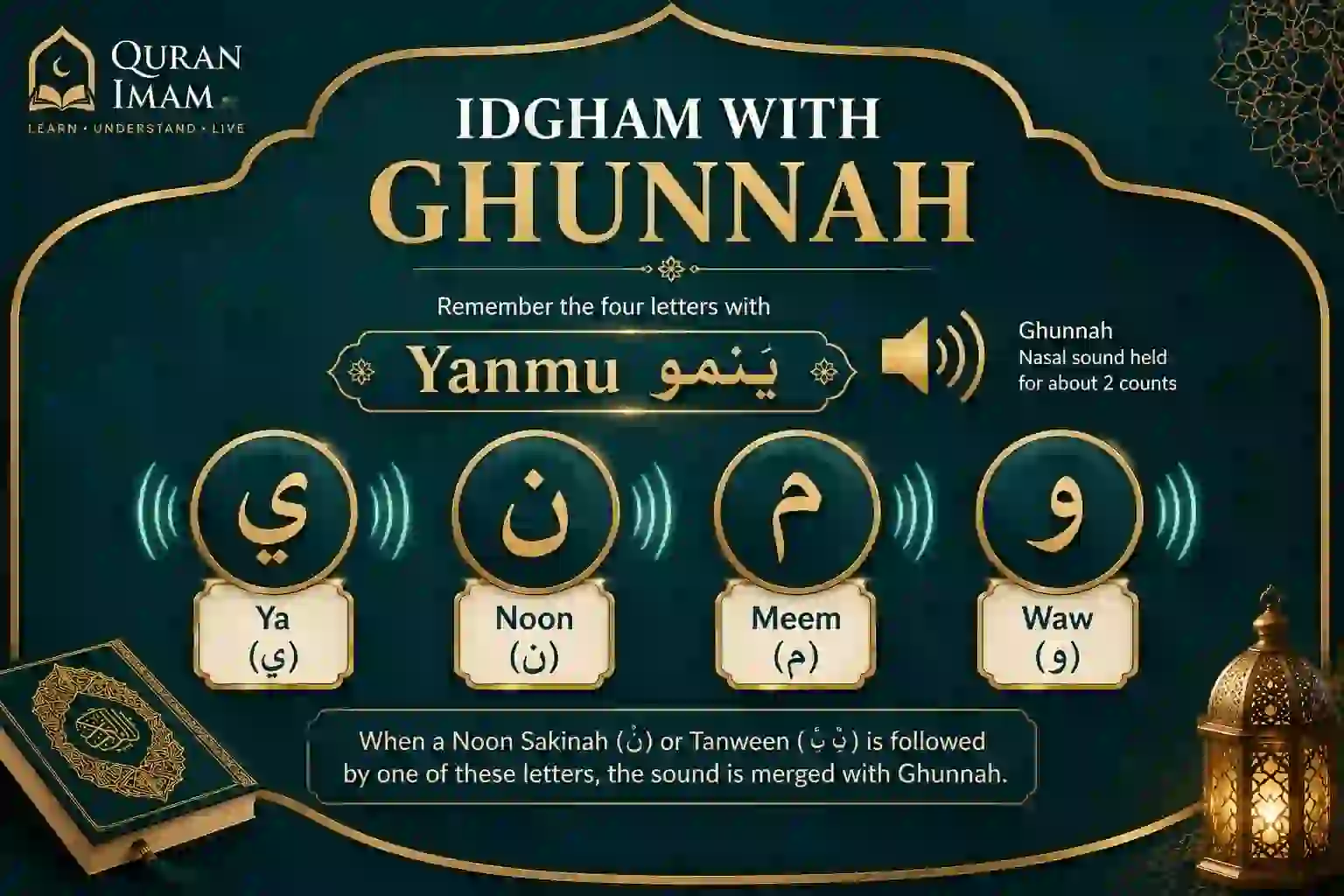
Unlike Yarmaloon, which contains all six Idgham letters, Yanmu includes only the four letters that require Ghunnah.
Most beginners memorise these letters quite quickly.
However, from our experience teaching hundreds of students, remembering the letters is rarely the difficult part. The real challenge is producing a balanced Ghunnah that is neither too long nor too short.
Students often improve this skill by listening carefully to qualified Quran teachers, repeating short passages several times, and receiving immediate correction whenever their pronunciation needs adjustment.
Those studying with a Private Quran Tutor: Personalised Quran Learning with Qualified Teachers usually develop this skill more quickly because every recitation receives personalised feedback, helping small mistakes disappear before they become long-term habits.
Idgham Letters without Ghunnah
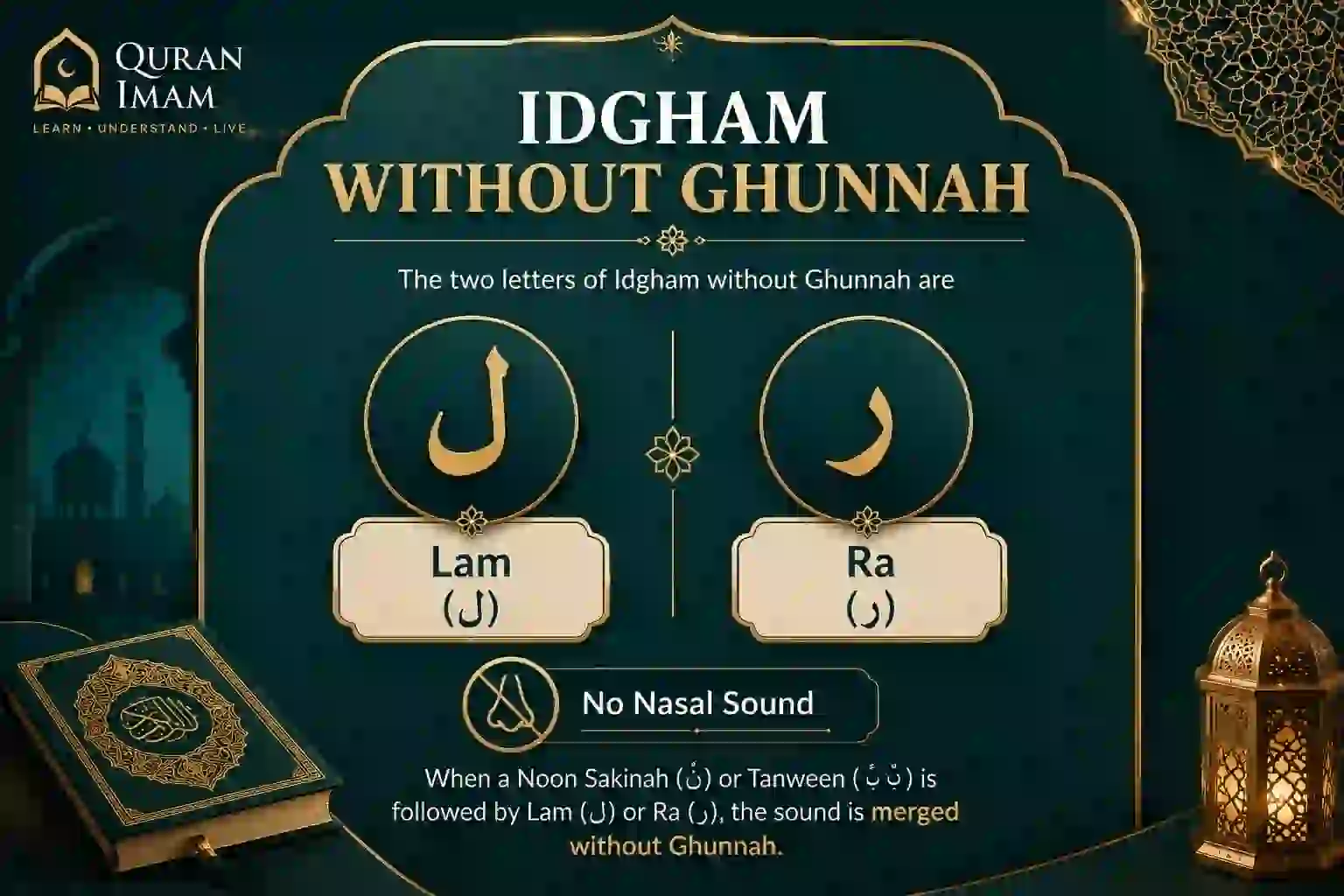
The remaining two Idgham letters are pronounced without Ghunnah. Unlike the previous group, the Noon Sakinah or Tanween merges directly into the following letter without producing a nasal sound.
Although there are only two letters in this category, they are among the most common places where beginners make mistakes because many learners assume every type of Idgham includes Ghunnah.
The Two Letters of Idgham without Ghunnah
The two letters are:
- Lam (ل)
- Ra (ر)
When a Noon Sakinah or Tanween is followed immediately by either Lam or Ra, the sound merges smoothly into the next letter without any nasalisation.
Many beginners instinctively add Ghunnah because they remember that the word belongs to the Idgham rule. However, this changes the correct pronunciation. With regular guidance and repeated practice, students gradually become able to distinguish between the two types of Idgham without hesitation.
Quran Examples of Idgham Letters
Reading real Quran examples is one of the best ways to understand how the rule works. Instead of memorising the rule in isolation, try identifying it while reading the Quran.
Examples of Idgham with Ghunnah
Example 1
- مِنْ وَلِيٍّ
The Noon Sakinah is followed by Waw (و), so the sound merges into the Waw with Ghunnah.
Example 2
- مِنْ نِعْمَةٍ
The Noon Sakinah is followed by Noon (ن), so Idgham with Ghunnah is applied.
Example 3
- وُجُوهٌ يَوْمَئِذٍ
The Tanween is followed by Ya (ي), so the Tanween merges into the Ya with Ghunnah.
Example 4
- خَيْرًا مِّنْهُ
The Tanween is followed by Meem (م), so Idgham with Ghunnah is applied.
Examples of Idgham without Ghunnah
Example 1
- مِنْ رَبِّهِمْ
The Noon Sakinah is followed by Ra (ر), so the sound merges without Ghunnah.
Example 2
- غَفُورٌ رَّحِيمٌ
The Tanween is followed by Ra (ر), so Idgham without Ghunnah is applied.
Example 3
- مِنْ لَدُنْهُ
The Noon Sakinah is followed by Lam (ل), so the Noon merges directly into the Lam without Ghunnah.
As you continue reading the Quran, you will notice these patterns appearing frequently. The more examples you encounter, the more naturally you will begin applying the rule.
Common Mistakes Beginners Make
Every beginner makes mistakes while learning Tajweed, and Idgham is no exception. The good news is that most of these mistakes disappear with regular guided practice.
Memorising the Letters but Not the Rule
Many students memorise Yarmaloon within a few minutes but still hesitate while reading because they are unsure when the rule should actually be applied.
Always remember that the presence of one of the six letters alone is not enough. The rule only applies when it is immediately preceded by a Noon Sakinah or Tanween.
Adding Ghunnah Everywhere
Another common mistake is applying Ghunnah to every example of Idgham.
Remember:
- Ya, Noon, Meem, and Waw are pronounced with Ghunnah.
- Lam and Ra are pronounced without Ghunnah.
Keeping these two groups separate will prevent many pronunciation errors.
Learn Quran Online Skype: Personalised Quran Lessons for Kids and Adults in the UK
Online Quran Academy Fees in the UK: What Should Families Expect to Pay?
Learning Theory Without Practice
Reading about Tajweed is helpful, but correct pronunciation develops through listening and recitation.
At Quran Imam, we regularly see students who know the definitions of Tajweed rules but struggle to apply them during real Quran reading. This is why our lessons focus on practical recitation alongside explanation, allowing students to build confidence through repeated practice and personalised feedback.
Trying to Learn Every Tajweed Rule at Once
Some beginners believe they need to master every Tajweed rule before they can read the Quran confidently.
In reality, learning one rule thoroughly before moving to the next usually leads to faster and more lasting progress.
Why Beginners Confuse Idgham with Ikhfa
One of the most common questions new learners ask is why Idgham sometimes sounds similar to Ikhfa.
The reason is that both rules involve Noon Sakinah or Tanween, and both can affect the way the sound is pronounced.
The key difference is that Idgham merges the sound into the following letter, while Ikhfa partially conceals the Noon sound without completely merging it.
During lessons, teachers often encourage students to listen carefully to experienced reciters before attempting to imitate the pronunciation themselves. Over time, the difference becomes much easier to recognise.
How to Practise Idgham at Home
Improving your Tajweed does not always require long study sessions. Small amounts of focused practice each day can make a significant difference.
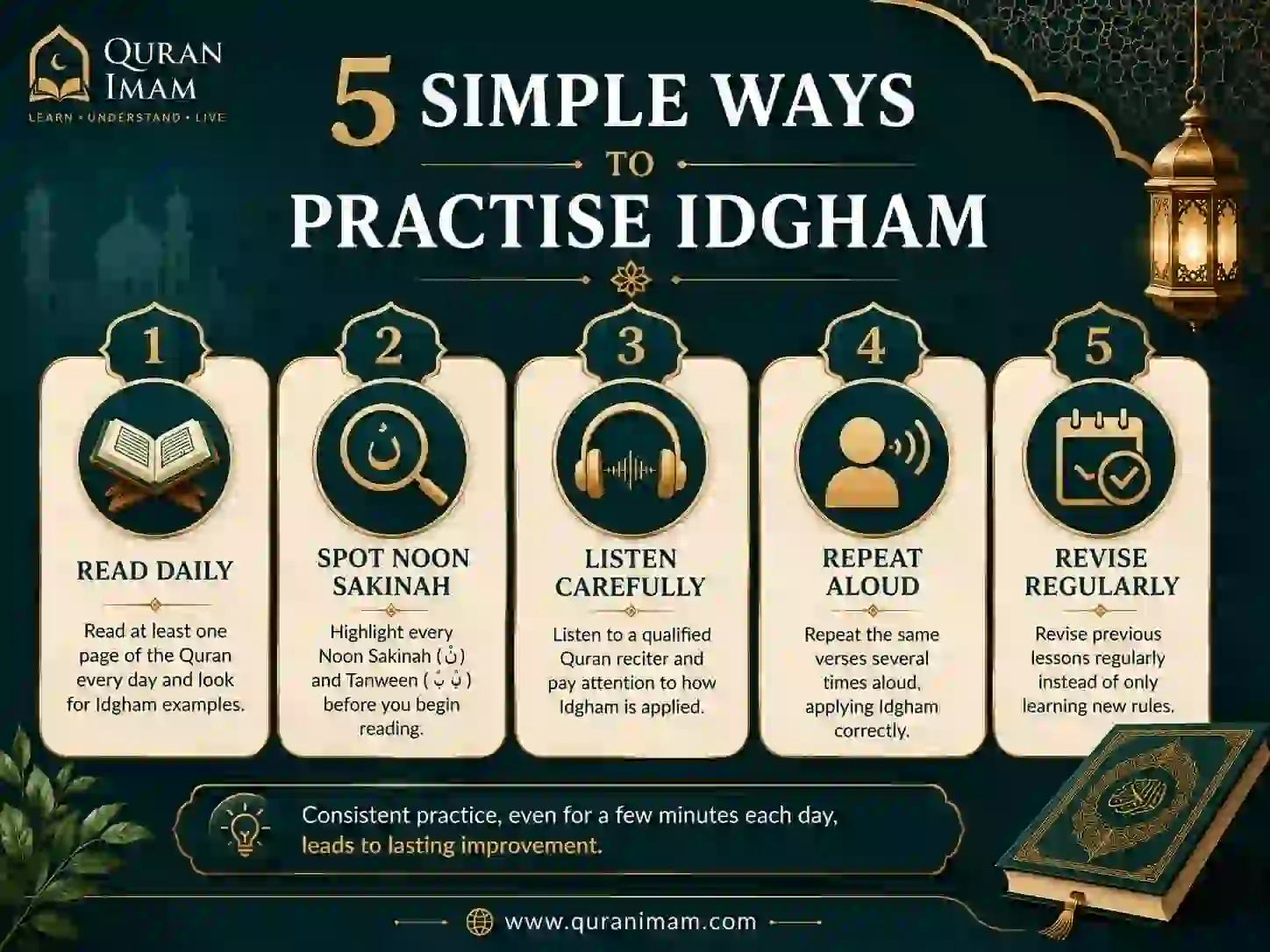
Try these simple techniques:
- Read one page of the Quran each day and look for Idgham examples.
- Highlight every Noon Sakinah and Tanween before you begin reading.
- Pause briefly to identify the following letter before reciting.
- Listen to a qualified Quran reciter and repeat the same verses several times.
- Record your own recitation and compare it with your teacher’s pronunciation.
- Revise previous lessons regularly instead of only learning new rules.
Based on our teaching experience, students who practise consistently for even ten minutes a day usually make steadier progress than those who study only once a week.
Final Thoughts
The Idgham letters form one of the most frequently used Tajweed rules in Quran recitation.
Although the concept is straightforward, applying it confidently requires patience, repetition, and regular correction. Rather than trying to memorise every Tajweed rule immediately, focus on recognising the six Idgham letters and understanding when the rule applies.
As your confidence grows, recognising Idgham will become increasingly natural, allowing you to read the Quran more smoothly and accurately.
Whether you are a complete beginner or revising your Tajweed after many years, consistent practice remains the key to long-term improvement.
Frequently Asked Questions
What are the six Idgham letters Explaind?
The six Idgham letters are Ya (ي), Ra (ر), Meem (م), Lam (ل), Waw (و), and Noon (ن). They are commonly remembered using the mnemonic Yarmaloon.
What is the difference between Idgham with Ghunnah and Idgham without Ghunnah?
Idgham with Ghunnah applies to Ya, Noon, Meem, and Waw, while Idgham without Ghunnah applies only to Lam and Ra.
When is Idgham Letters applied?
Idgham is applied when a Noon Sakinah or Tanween is immediately followed by one of the six Idgham letters.
Is Idgham difficult to learn?
Most beginners find the concept easy to understand. The greatest challenge is applying it consistently during recitation, which becomes easier through regular practice and guidance from a qualified teacher.
Can children learn Idgham?
Yes. Children often learn the Idgham rule successfully through gradual practice, repetition, and personalised correction. Short, consistent lessons are generally more effective than occasional long study sessions.
Do I need to memorise every Tajweed rule before reading the Quran?
No. Most students make better progress by learning Tajweed step by step while continuing to read the Quran under the guidance of an experienced teacher.

Continue Your Tajweed Journey with Quran Imam
Understanding the Idgham letters is an important milestone in learning Tajweed, but true confidence comes through guided practice and consistent recitation.
At Quran Imam, our qualified Al-Azhar teachers provide personalised one-to-one online Quran lessons for children, adults, and new Muslims across the UK. Every lesson is tailored to the student’s level, ensuring that Tajweed rules such as Idgham are taught through practical recitation, patient correction, and continuous encouragement.
Whether you are learning the Quran for the first time or looking to improve your Tajweed, our teachers will help you develop accurate pronunciation at a pace that suits your ability.
Book your free trial lesson today and discover how personalised Quran learning can help you recite with greater confidence and accuracy.