

Table of Contents
- Quick Answer: What Is Ikhfa Shafawi?
- What Is Ikhfa Shafawi?
- What Is the Ikhfa Shafawi Rule?
- How to Recognise Ikhfa Shafawi in the Quran
- How to Pronounce Ikhfa Shafawi
- Does Ikhfa Shafawi Have Ghunnah?
- Why Is It Called Ikhfa Shafawi?
- Ikhfa Shafawi Examples from the Quran
- The Three Rules of Meem Sakinah
- Ikhfa Shafawi vs Ikhfa Haqiqi
- Ikhfa Shafawi vs Idgham Shafawi and Izhar Shafawi
- Common Mistakes Beginners Make
- How to Practise Ikhfa Shafawi
- Do Children Need to Learn Ikhfa Shafawi?
- Frequently Asked Questions
- Learn Tajweed with Personalised Guidance
Quick Answer: What Is Ikhfa Shafawi?
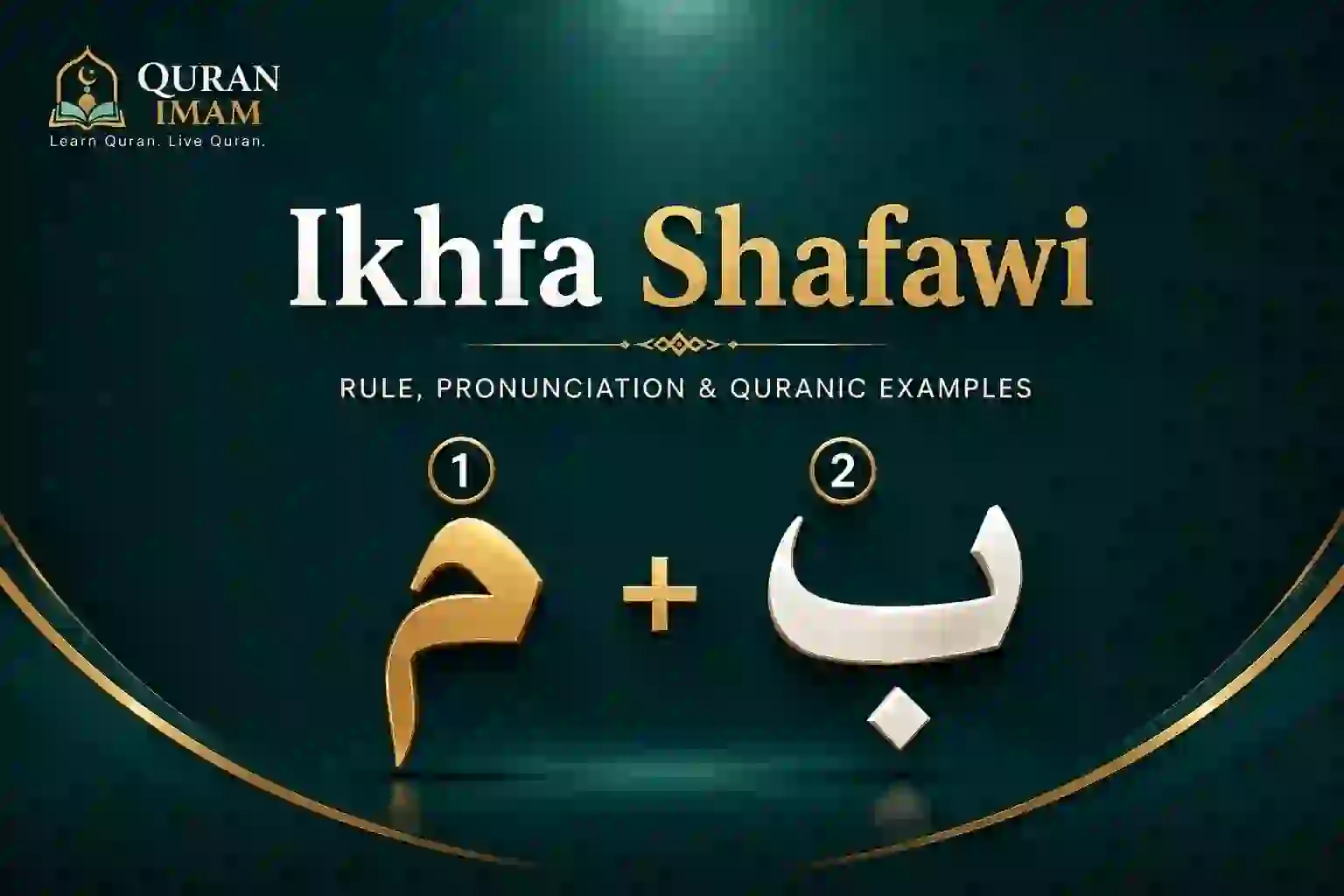
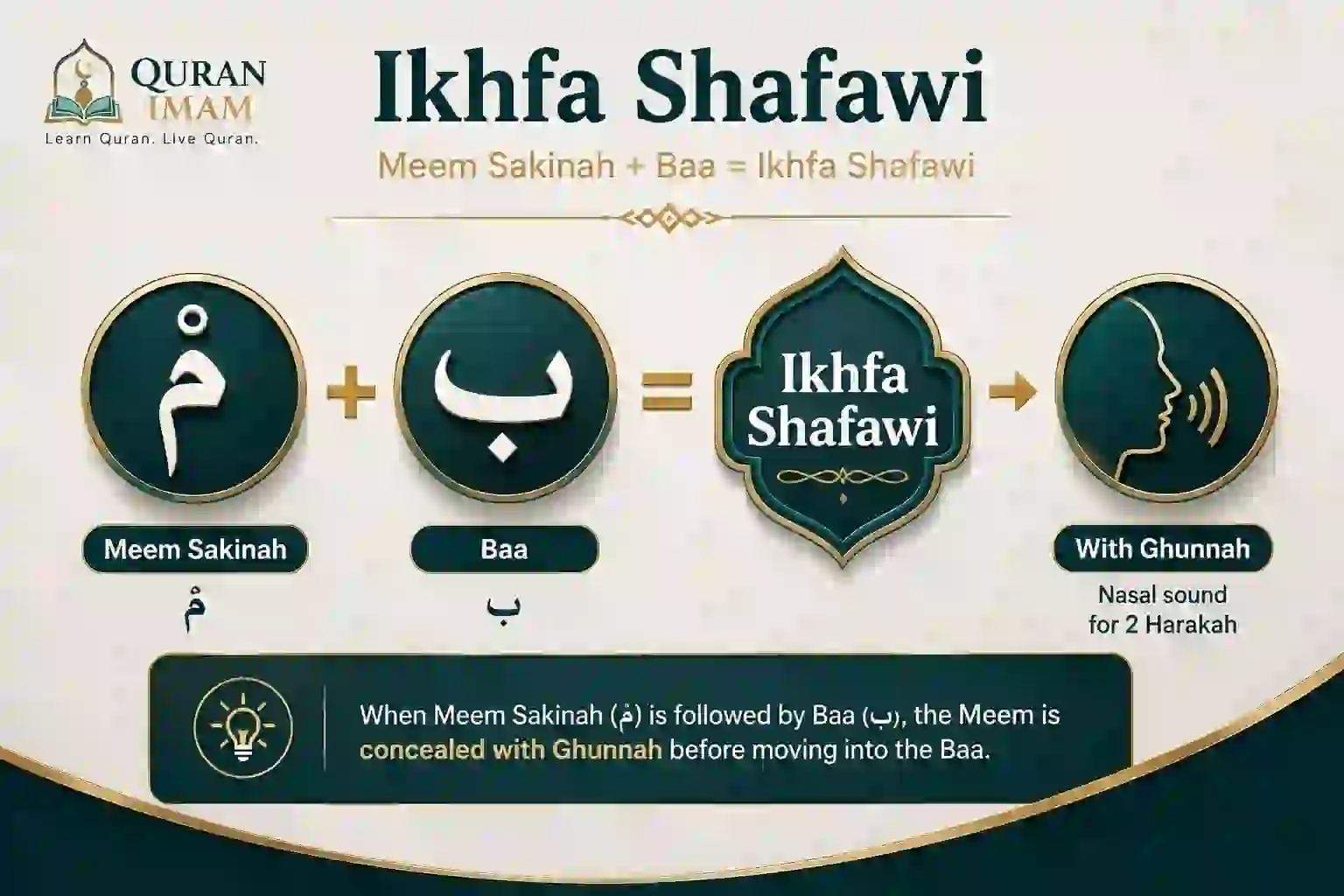
Ikhfa Shafawi (إخفاء شفوي) is a Tajweed rule that occurs when Meem Sakinah (مْ) is followed by the letter Baa (ب).
The Meem is concealed rather than pronounced with full clarity, while Ghunnah is maintained before the reciter moves naturally into the Baa.
The easiest pattern to remember is:
مْ + ب = Ikhfa Shafawi
Only one letter triggers Ikhfa Shafawi:
Baa (ب)
For beginners, recognising this pattern is the most important first step. The correct sound is then developed through listening, repetition and guided correction.
What Is Ikhfa Shafawi?
Ikhfa Shafawi is one of the three rules of Meem Sakinah in Tajweed.
A Meem Sakinah is the Arabic letter Meem carrying a sukoon:
(مْ)
When this Meem is followed by Baa, Ikhfa Shafawi applies.
The two parts of the name help explain the rule.
Ikhfa
Ikhfa (إخفاء) means concealment.
In this rule, the Meem is not pronounced with the full clarity associated with Izhar, nor is it completely merged into the following letter.
Shafawi
Shafawi (شفوي) relates to the lips.
Meem and Baa are both articulated using the two lips, which is why this rule is described as Shafawi.
For a beginner, however, you do not need to memorise a complicated definition first.
Start with one simple rule:
Meem Sakinah followed by Baa = Ikhfa Shafawi.
Once you can recognise this combination while reading, learning the correct pronunciation becomes much easier.
What Is the Ikhfa Shafawi Rule?
The rule is straightforward:
When Meem Sakinah (مْ) is followed by Baa (ب), Ikhfa Shafawi applies.
The Baa is the only letter that causes this rule.
For example:
تَرْمِيهِمْ بِحِجَارَةٍ
This phrase occurs in Surah Al-Fil,
The Meem at the end of تَرْمِيهِمْ is followed by the Baa at the beginning of بِحِجَارَةٍ.
Therefore:
مْ + ب → Ikhfa Shafawi
During continuous recitation, the Meem should not be pronounced as an entirely separate, fully clear sound. Instead, the reciter applies the Ikhfa with Ghunnah and transitions naturally into the Baa.
The rule can occur across two words, which is why paying attention to the next letter is important when reading the Quran.
How to Recognise Ikhfa Shafawi in the Quran
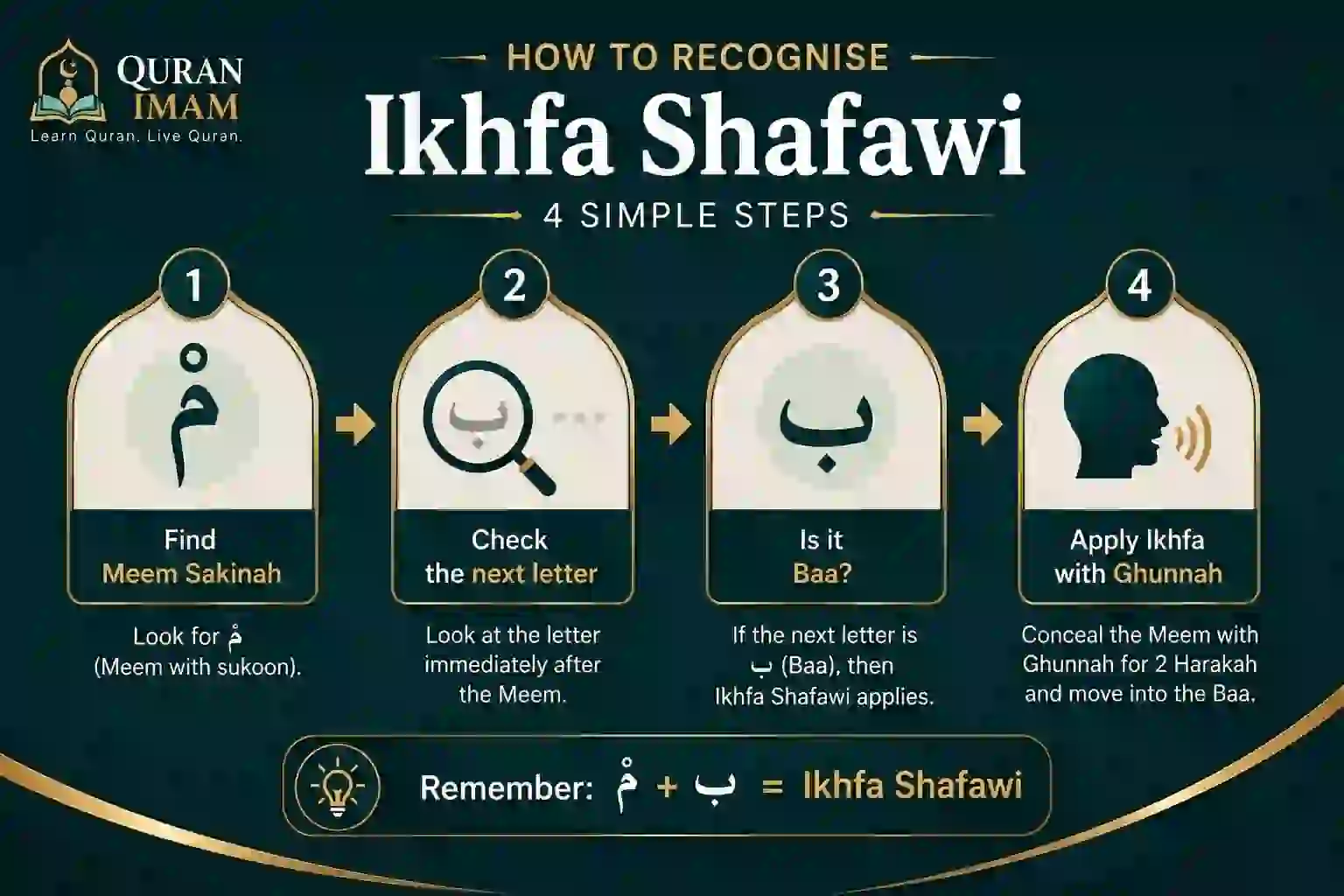
You can identify the rule using four simple steps.
Step 1: Find Meem Sakinah
Look for:
مْ
This is the Meem carrying a sukoon.
Step 2: Check the Next Letter
Look at the letter immediately following the Meem.
Do not look only at the rest of the current word. The next letter may be at the beginning of the following word.
Step 3: Look for Baa
If the next letter is:
ب
then Ikhfa Shafawi applies.
Step 4: Apply the Rule
Maintain the appropriate Ghunnah and transition naturally into the Baa.
With repeated Quran reading, this recognition can become almost automatic. Instead of consciously analysing every letter, the student gradually learns to recognise familiar Tajweed patterns while reciting.
How Do You Pronounce Ikhfa Shafawi?
Knowing the definition is only part of learning Tajweed.
The practical skill comes from hearing the correct recitation, repeating it and receiving correction.
When you see:
مْ + ب
try the following sequence:
- Recognise the Meem Sakinah.
- Prepare the lips for the Meem.
- Maintain the appropriate Ghunnah.
- Avoid making the Meem excessively clear and separate.
- Keep the sound controlled rather than exaggerated.
- Move naturally into the following Baa.
The aim is not to make the Meem disappear.
Instead, the Meem is concealed in a way that distinguishes Ikhfa from both Izhar and Idgham.
A common beginner misunderstanding is to think that “Ikhfa” means completely hiding or removing the letter. It does not. The Meem still has a role in the recitation, but it is not pronounced with the same complete clarity used in Izhar Shafawi.
For this reason, pronunciation is usually easier to learn by listening to a qualified Quran teacher or reciter than by reading a written description alone.
Does Ikhfa Shafawi Have Ghunnah?
Yes.
Ikhfa Shafawi is accompanied by Ghunnah, the nasal quality used in several Tajweed rules.
It is commonly taught with a duration of two harakah (two counts).
However, counting by itself does not guarantee correct pronunciation.
A student also needs to develop:
- The correct quality of the Ghunnah.
- Appropriate lip positioning.
- A smooth transition from Meem to Baa.
Control over the length and strength of the sound.
One common problem is making the Ghunnah too long or too forceful.
Another is losing the Ghunnah altogether and moving immediately from the Meem into the Baa.
The goal is a controlled and natural recitation.
This is one reason practical correction is valuable. A learner may understand the rule perfectly in theory but still need help hearing and correcting a small pronunciation error.
Why Is It Called Ikhfa Shafawi?
The name becomes easier to remember when you separate its two parts:
Part Meaning
Ikhfa Concealment — the Meem is not pronounced with full Izhar
Shafawi Relating to the lips
In simple terms:
Ikhfa Shafawi is the concealment of Meem Sakinah before Baa, accompanied by Ghunnah and applied through the lips.
For beginners, the most useful memory aid remains:
مْ + ب = Ikhfa Shafawi
Ikhfa Shafawi Examples from the Quran
The easiest way to understand a Tajweed rule is to see it in actual Quranic recitation.
Example 1: Surah Al-Fil
تَرْمِيهِمْ بِحِجَارَةٍ
Surah Al-Fil,
The Meem at the end of تَرْمِيهِمْ is followed by Baa in بِحِجَارَةٍ.
Therefore:
مْ + ب = Ikhfa Shafawi
This is a useful beginner example because Surah Al-Fil is familiar to many students and the Meem-Baa sequence is easy to identify.
Example 2: Surah Al-Baqarah
فَلَمَّا أَنبَأَهُمْ بِأَسْمَائِهِمْ
Surah Al-Baqarah, 2:33
Here, the Meem at the end of أَنبَأَهُمْ is followed by Baa in بِأَسْمَائِهِمْ.
Again:
مْ + ب = Ikhfa Shafawi
This example is particularly useful because it demonstrates that the rule can occur across a word boundary during continuous recitation.
Example 3: Surah At-Takwir
وَمَا صَاحِبُكُم بِمَجْنُونٍ
Surah At-Takwir,
The Meem at the end of صَاحِبُكُم is followed by Baa in بِمَجْنُونٍ.
So once again:
مْ + ب = Ikhfa Shafawi
This gives learners another example to practise after becoming familiar with تَرْمِيهِمْ بِحِجَارَةٍ.
Ikhfa Shafawi at a Glance
Element Rule
Letter before Meem Sakinah (مْ)
Letter after Baa (ب)
Tajweed rule Ikhfa Shafawi
Ghunnah Yes
Commonly taught duration Two harakah
Main articulation Lips
The key pattern to remember is:
مْ + ب → Ikhfa Shafawi
The Three Rules of Meem Sakinah
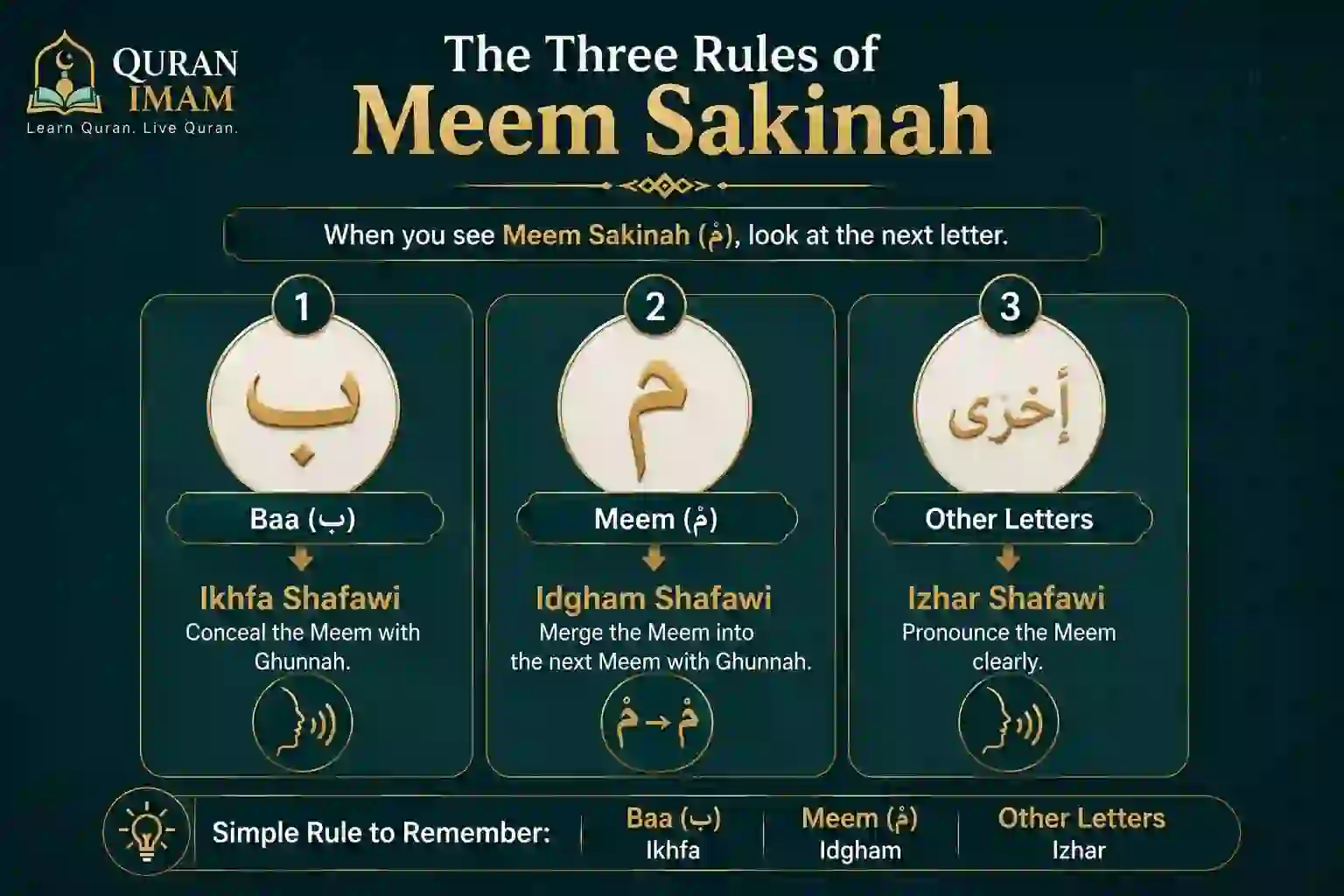
Ikhfa Shafawi becomes much easier when you understand it alongside the other two rules of Meem Sakinah.
When you see مْ, simply check the next letter.
Letter after Meem Sakinah Rule Basic pronunciation
Baa (ب) Ikhfa Shafawi Concealed Meem with Ghunnah
Meem (م) Idgham Shafawi Meem is merged with the following Meem, with Ghunnah
Any other letter Izhar Shafawi Meem is pronounced clearly
This gives beginners a simple system instead of requiring them to memorise three unrelated definitions:
Baa → Ikhfa
Meem → Idgham
Other letters → Izhar
Ikhfa Shafawi vs Ikhfa Haqiqi
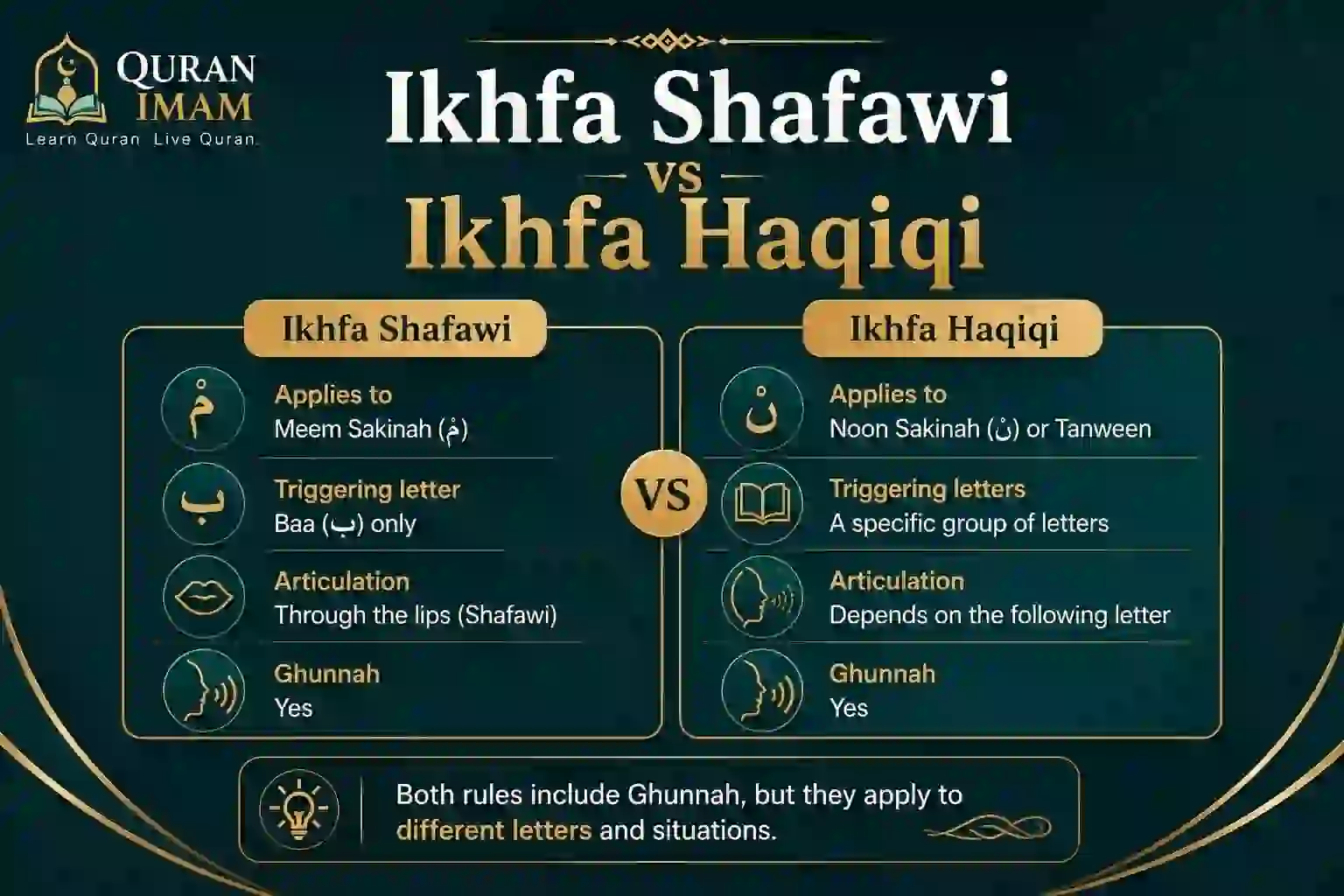
The names can be confusing because both rules contain the word Ikhfa, but they apply to different letters and situations.
Ikhfa Shafawi Ikhfa Haqiqi
Applies to Meem Sakinah (مْ) Noon Sakinah (نْ) or Tanween
Triggering letters Baa (ب) only A specific group of letters
Main articulation Lips Depends on the following letter
Ghunnah Yes Yes
The easiest way to distinguish them is to identify the letter involved.
If you see:
مْ + ب
think:
Ikhfa Shafawi
If you are dealing with Noon Sakinah or Tanween, you may be studying a different rule such as Ikhfa Haqiqi, depending on the following letter.
Ikhfa Shafawi vs Idgham Shafawi and Izhar Shafawi
These three rules can be confusing when students first study Meem Sakinah.
The easiest way to distinguish them is to look at the letter that comes immediately after the Meem.
Next letter Rule Basic application
Baa (ب) Ikhfa Shafawi Concealment with Ghunnah
Meem (م) Idgham Shafawi Merging with Ghunnah
Any other letter Izhar Shafawi Clear Meem pronunciation
So remember:
Baa = Ikhfa
Meem = Idgham
Everything else = Izhar
An Important Point About Izhar Shafawi
When Meem Sakinah is followed by Waw (و) or Fa (ف), beginners are often advised to pay particular attention to the Meem.
Because these letters are closely associated with lip articulation, a learner may unintentionally allow the Meem to blend or develop an unwanted nasal quality.
The Meem should remain clear, without turning the pronunciation into Ikhfa or Idgham.
This is a small detail, but it can be useful when a student is working on accurate Meem Sakinah pronunciation.
Common Mistakes Beginners Make
Understanding a Tajweed rule in theory does not always mean that a learner can apply it correctly during continuous Quran recitation.
From teaching experience, beginners commonly encounter several difficulties.
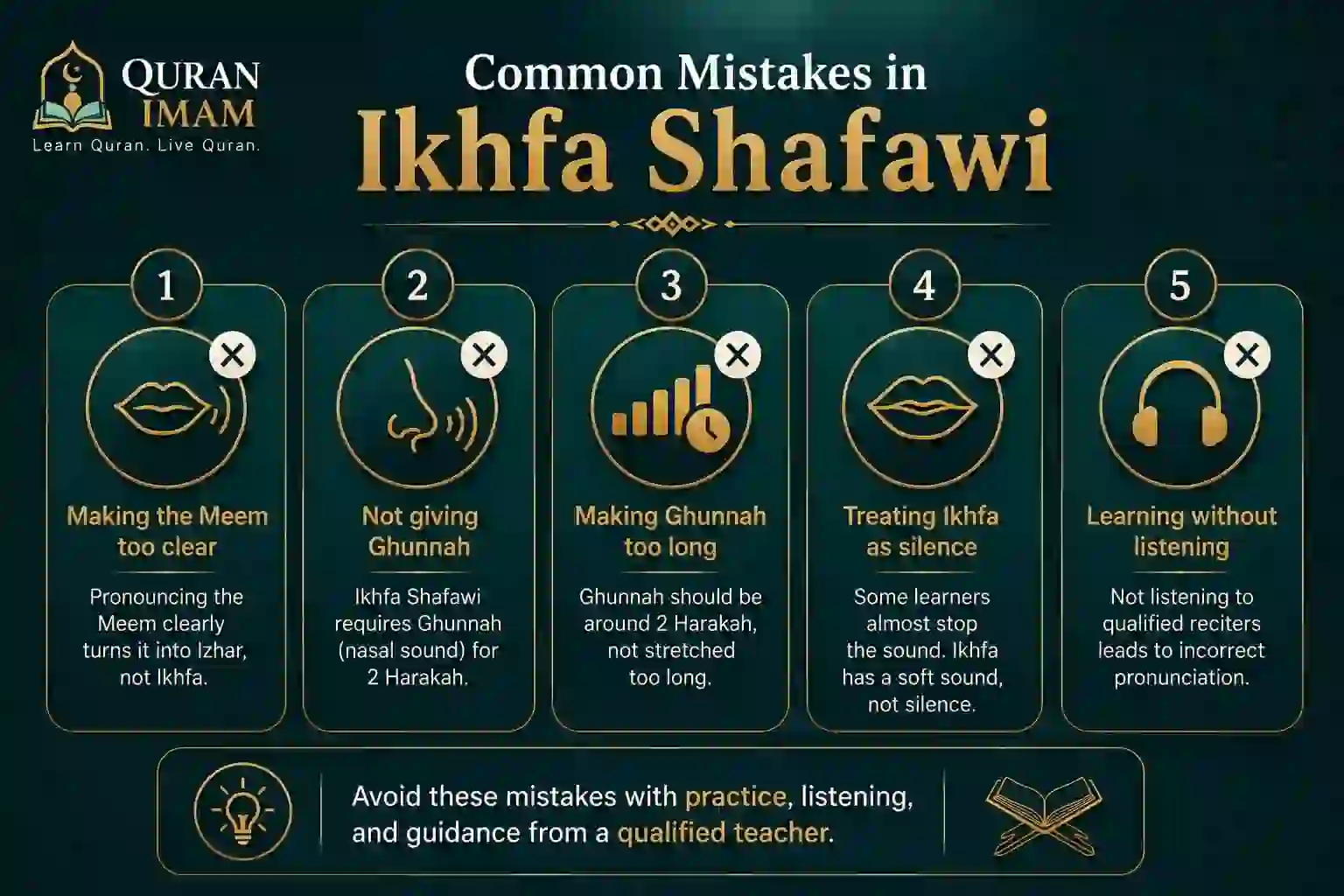
1. Making the Meem Too Clear
A student may pronounce the Meem as a completely separate and fully clear sound before moving to Baa.
This can make the pronunciation closer to Izhar than Ikhfa.
2. Losing the Ghunnah
Another common mistake is moving too quickly from Meem to Baa without maintaining the required nasal quality.
3. Holding the Ghunnah Too Long
The opposite problem can also happen.
A learner may exaggerate the Ghunnah or hold it noticeably longer than intended.
Tajweed is not about making every sound as long or as strong as possible. Controlled pronunciation is important.
4. Treating Ikhfa as Silence
Ikhfa does not mean that the Meem disappears.
The Meem remains part of the recitation, but its sound is concealed rather than pronounced with full clarity.
5. Confusing Baa with the Other Meem Rules
When a student first learns the three rules of Meem Sakinah, it is easy to forget which letter triggers which rule.
Use the simple pattern:
Baa → Ikhfa
Meem → Idgham
Other letters → Izhar
6. Learning the Definition Without Listening
A student may be able to answer:
“Meem Sakinah before Baa is Ikhfa Shafawi.”
Yet when reading تَرْمِيهِمْ بِحِجَارَةٍ, they may still make the Meem too clear, lose the Ghunnah or overextend it.
This is completely normal.
Tajweed is a practical recitation skill, so listening, repetition and correction are essential.
How Can Beginners Practise Ikhfa Shafawi?
You do not need to memorise dozens of examples at once.
A short and consistent practice routine is often more useful.
Step 1: Learn the Pattern
Start with:
مْ + ب = Ikhfa Shafawi
Step 2: Find It While Reading
Look for Meem Sakinah followed by Baa in familiar Quranic passages.
Start with examples you already know, such as:
تَرْمِيهِمْ بِحِجَارَةٍ
Step 3: Listen Before Repeating
Listen carefully to a qualified Quran teacher or reliable recitation.
Pay attention to:
- The Ghunnah.
- The lip position.
- The transition into Baa.
- The length of the sound.
Step 4: Practise Slowly
Read the phrase slowly enough to recognise:
Meem → Ghunnah → Baa
Do not rush through the example simply because you already know the words.
Step 5: Practise in Context
After practising the individual phrase, read the entire verse.
The goal is not to stop and analyse every Meem during normal recitation. The goal is for correct application to become increasingly natural.
Step 6: Get Your Recitation Corrected
A teacher can identify small pronunciation problems that a learner may not notice independently.
This is particularly useful when working on Makharij, Ghunnah and the rules of Meem Sakinah.
Do Children Need to Learn Ikhfa Shafawi?
Yes. Children learning Quran with Tajweed will eventually need to understand the rules of Meem Sakinah, including Ikhfa Shafawi.
However, the teaching method should match the child’s age, reading ability and learning style.
A younger learner may benefit from:
- Listening and repetition.
- Short Quranic examples.
- Simple explanations.
- Immediate pronunciation correction.
- Regular revision.
- Gradual introduction of Tajweed terminology.
Some children learn particularly well through listening and repetition, while others benefit from seeing a rule explained visually and then practising it during reading.
This is why personalised teaching can be useful.
Instead of expecting every child to move through Tajweed at exactly the same pace, a teacher can adjust the lesson according to the learner’s current ability.
For families looking for structured Quran lessons for children, our Learn Quran for Kids programme can be a relevant next step.
Best Online Quran Classes Reviews: How to Choose the Right Quran Academy in the UK
Online Quran Academy Fees in the UK: What Should Families Expect to Pay?
Tajweed Is More Than Memorising Rules
One of the most important things to understand about Tajweed is that knowing a rule and applying it are two different skills.
A student may know exactly when Ikhfa Shafawi occurs but still need time to produce the correct sound naturally during continuous recitation.
This is especially common among beginners who are still developing:
- Arabic letter recognition.
- Makharij.
- Reading fluency.
- Confidence when reading aloud.
- Familiarity with Tajweed rules.
At Quran Imam, our teaching experience shows that students often benefit from repeated guided recitation, immediate correction and consistent practice.
Progress varies from one learner to another. It can depend on the student’s starting level, lesson frequency, attendance, home practice and individual learning ability.
For students who are still developing their basic Quran reading skills, our guide on How to Read Quran for Beginners can help explain the wider journey from learning Arabic letters to reading Quranic passages with greater confidence.
Frequently Asked Questions About Ikhfa Shafawi
What is Ikhfa Shafawi?
Ikhfa Shafawi is a Tajweed rule that occurs when Meem Sakinah (مْ) is followed by Baa (ب). The Meem is concealed with Ghunnah before the reciter moves into the Baa.
How many letters cause Ikhfa Shafawi?
Only one letter causes Ikhfa Shafawi:
Baa (ب).
Does Ikhfa Shafawi have Ghunnah?
Yes. Ikhfa Shafawi is accompanied by Ghunnah and is commonly taught with a duration of two harakah.
What is an example of Ikhfa Shafawi in the Quran?
One well-known example is:
تَرْمِيهِمْ بِحِجَارَةٍ
from Surah Al-Fil,
The Meem is followed by Baa, so Ikhfa Shafawi applies.
What are the three rules of Meem Sakinah?
The three main rules are:
- Ikhfa Shafawi — before Baa.
- Idgham Shafawi — before Meem.
- Izhar Shafawi — before other letters.
What is the difference between Ikhfa Shafawi and Ikhfa Haqiqi?
Ikhfa Shafawi applies to Meem Sakinah before Baa, while Ikhfa Haqiqi applies to Noon Sakinah or Tanween before its designated letters.
Can children learn Ikhfa Shafawi?
Yes. Children can learn it gradually through listening, repetition, short Quranic examples and regular correction. The pace should be adapted to their age and reading ability.
Can I learn Ikhfa Shafawi online?
Yes. One-to-one online Quran lessons allow a teacher to listen to your recitation and provide individual correction. Consistent practice and qualified guidance remain important whether lessons take place online or in person.
Learn Tajweed with Personalised, One-to-One Guidance
Reading about Ikhfa Shafawi is a useful first step.
Applying the rule correctly while reciting the Quran is the next step — and that requires practice, listening and correction.
At Quran Imam, students learn Quran recitation and Tajweed through one-to-one online lessons with qualified teachers. Lessons can be adapted to the learner’s current reading level, goals and pace.
Whether you are:
- Learning to read the Quran from the beginning.
- Improving your pronunciation.
- Studying Tajweed rules.
- Working on Quran recitation.
- Looking for structured Quran lessons for your child.
the aim is not simply to memorise the names of Tajweed rules.
It is to understand them, apply them correctly and gradually become a more confident Quran reader.
Book Your Free Trial Lesson
Experience a personalised Quran lesson and discuss your learning goals with a qualified teacher before deciding on your learning plan.
Learn Quran with guidance, consistency and a learning approach suited to you.
Book Your Free Trial Lesson →